August 12, 2026 • Margot Calloway • 9 min reading time • Prices verified June 4, 2026
Baffle Box vs. Sewn-Through: The Construction Spec That Decides Warmth Distribution
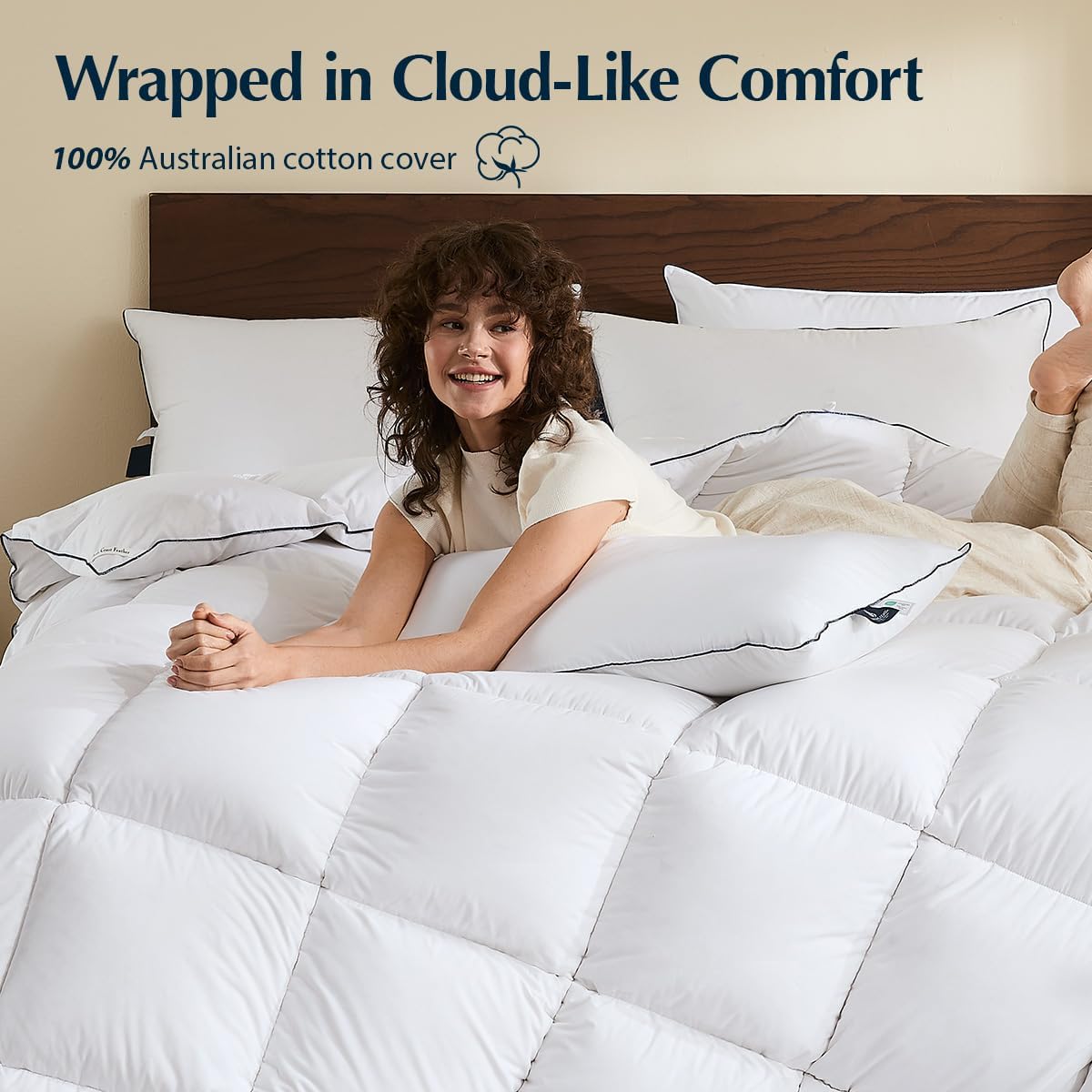
Think of a down comforter as a grid of little pockets holding your fill — the warmth you paid for. The way those pockets are made is called the construction method, and there are exactly two mainstream options. Sewn-through (sometimes called “stitch-through”) sews the top and bottom shell fabric directly together in a grid pattern, creating flat, defined squares with no depth. Baffle box sews a thin fabric wall — the “baffle” — between the top and bottom layers, so each box becomes a three-dimensional chamber that lets the down loft upward. That loft is everything. Down insulates by trapping air in tiny clusters; compress those clusters flat, and you’re paying for fill power that can’t do its job. Understanding this single spec will make you a faster, more confident buyer whether you’re choosing your first real comforter or upgrading a short-term rental fleet.
| EDITOR'S PICKGlobon King Size Down Comforter… | Mid-tierC&W Goose Down Comforter Queen… | Budget pickThree Geese Queen Size Goose Fe… | |
|---|---|---|---|
| Size | King | Queen | Queen |
| Fill material | Down | Goose down | Goose feather/fiber |
| Fill power | — | 750+ | — |
| Construction | — | 3D baffle box | Baffle box |
| Shell material | — | 100% cotton | — |
| Corner tabs | 8 corner tabs | — | 8 corner loops |
| Price | $162.99 | $140.00 | $55.82 |
| See on Amazon → | See on Amazon → | See on Amazon → |
Why Construction Method Is a Warmth Decision, Not Just a Design Decision
Most buyers fixate on fill power (the fluffiness rating of the down itself) and fill weight (how many ounces of down are inside). Both matter. But the same under-discussed variable surfaces consistently across independent editorial sources including Wirecutter’s “The Best Down Comforter” roundup (New York Times, 2025) and Good Housekeeping’s “How to Buy a Down Comforter” (2025): construction determines whether that fill power is actually realized in use.
Here’s the physical reality. A 700-fill-power down cluster can reach roughly 700 cubic inches of loft per ounce — but only if it has room to expand. In a sewn-through construction, every seam is a cold zone. The thread compresses the shell fabric all the way through, pinching the fill and creating a grid of thin, under-insulated lines across the entire surface. You’ve seen this in person: the perfectly flat seam lines on a budget comforter. They’re not decorative — they’re a thermal weak point. Owners consistently describe sewn-through comforters as feeling adequate in the center of each square but noticeably cooler at the seam lines, especially on cold nights.
Baffle box eliminates this by inserting a vertical fabric wall between the top and bottom shells. The fill in each box can expand upward and sideways without being compressed by the outer seam. The Sleep Foundation’s editorial overview “Best Down Comforters” (2025) specifically notes that baffle-box construction allows down to fully loft, which directly translates to more consistent warmth distribution across the whole sleeping surface.
The tradeoff is real: baffle box requires more fabric, more stitching passes, and more precise construction. That cost lands in the price tag. The construction method is one of the clearest signals of where a comforter sits on the quality ladder.
Budget, Mid-Tier, and Premium: How Construction Maps to Each Spending Level
Addressing construction choice in the abstract is useful only up to a point. What most buyers actually need is a clear map of which construction belongs at which price tier — and why. The three tiers below reflect how the construction spec plays out in real purchase decisions.
Budget Tier ($60–$150): When Sewn-Through Is Honestly the Right Call

Three
$55.82
In stock on Amazon
Check price on AmazonAt this price level, baffle-box construction is rarely available, and that is not a reason to avoid the category entirely. Sewn-through comforters from brands like Beckham Hotel Collection and comparable value-tier options are genuinely sufficient for the use cases where budget buyers most commonly land: guest rooms, warm-climate households, warm-sleepers buying a lighter summer option, and short-term rental units in temperate markets where peak warmth performance is not the primary need.
The Spruce, in its editorial coverage of comforter construction (“Baffle Box vs. Sewn-Through Comforters,” 2024), notes that sewn-through designs tend to lay flatter and look crisper inside a duvet cover — which matters in contexts like Airbnb listings where a clean, made-bed appearance drives first impressions in listing photography.
The honest case for sewn-through at this tier: if you run warm, sleep in a mild climate, or are buying a seasonal comforter rather than a year-round one, flat construction works in your favor. Less trapped air means less heat buildup. You are not buying performance you don’t need, and you are not paying for construction overhead you won’t benefit from.
Where budget sewn-through falls short: cold climates, cold sleepers, and year-round use in sub-60°F bedrooms. At those use cases, the cold seam lines become a nightly frustration rather than an acceptable tradeoff.
Three
$55.82
In stock on Amazon
Check price on AmazonMid-Tier ($150–$400): Where Construction Choice Becomes Consequential
C&W
$140.00
In stock on Amazon
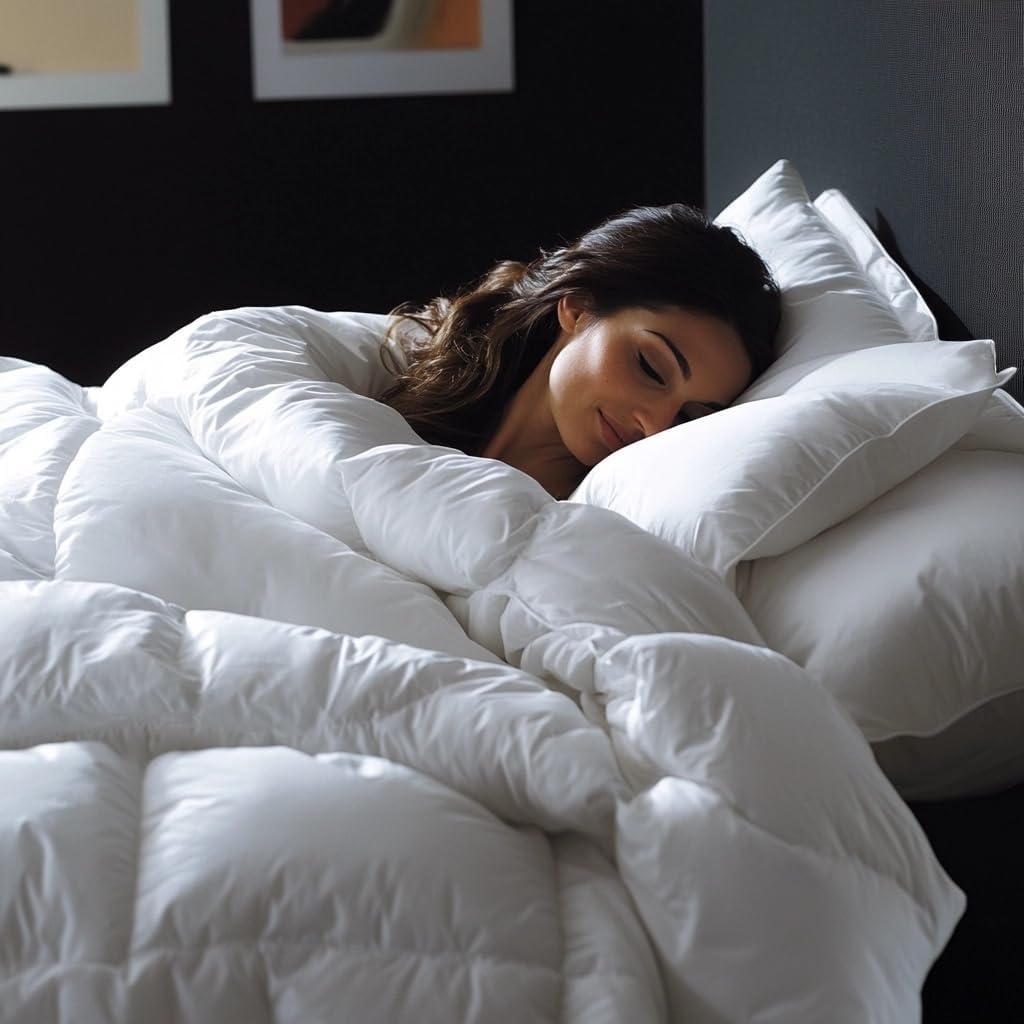
Check price on AmazonThis is the tier where both construction options exist at competitive prices, which means the construction decision is most consequential and most often made without full information. Brooklinen’s Down Comforter and Parachute’s Down Comforter both use baffle-box construction as a standard feature at this level. Wirecutter’s “The Best Down Comforter” (New York Times, 2025) flags baffle-box construction specifically as a reason certain mid-tier options perform above their fill-power rating in warmth consistency — because the fill has room to work.
The practical math for a buyer with two options priced within $50 of each other: a comforter used 300 nights per year for eight years represents roughly 2,400 uses. A $50 premium at purchase is approximately two cents per night for a physically real improvement in warmth delivery. At this tier, the construction gap almost always justifies the premium.
Good Housekeeping’s “How to Buy a Down Comforter” (2025) recommends a minimum 230-thread-count, down-proof weave for any baffle-box comforter at this tier — a spec worth confirming in the product description before purchase. A well-engineered baffle box in a too-loosely woven shell will shed down clusters through the fabric itself over time, undermining the construction advantage you paid for.
Mid-tier buyers investing in fill power 650 and above should treat sewn-through construction as a spec mismatch. You are buying performance you cannot fully access if the fill cannot loft. The construction has to match the fill.
C&W
$140.00
In stock on Amazon
Check price on AmazonPremium Tier ($500–$1,500+): Baffle Box Is Assumed — Now Read the Engineering Details
Globon
$162.99
In stock on Amazon
Check price on AmazonAt the Sferra, Frette, Matouk, and upper Boll & Branch tier, baffle-box construction is table stakes. The meaningful differentiation shifts to how precisely the baffle box is engineered. Three spec-level details are worth confirming from published product documentation before purchase at this level.
Box size. Smaller boxes — typically 4–6 inch grids — hold down in more precisely distributed pockets and reduce fill migration more effectively than larger boxes. Sferra’s product documentation for the Bari and Milano lines specifies 6-inch box sizing, which supports the stable, even loft that editorial reviewers associate with the price point.
Baffle fabric weight. Thinner, lighter baffles are preferable in premium applications because they add less structural mass. The shell and baffle combined should remain light enough that the fill’s loft is the dominant physical experience. Matouk and Sferra both document the use of fine-weight baffle fabric in their higher-tier lines — what product specifications describe as whisper-weight construction — supporting loft without adding bulk.
Shell thread count and down-proof weave. Good Housekeeping’s “How to Buy a Down Comforter” (2025) establishes 230-thread-count as a floor; premium options from Sferra and Matouk typically run 300–400 TC with a sateen or percale weave certified for down containment. This is the spec that prevents strike-through — down clusters migrating through the shell fabric itself — which is a failure mode specific to premium-fill, high-loft constructions in lower-quality shells.
Wirecutter’s “The Best Down Comforter” (New York Times, 2025) and the Sleep Foundation’s “Best Down Comforters” (2025) editorial notes both identify box size and shell construction as the variables where heirloom-grade longevity is won or lost at the premium tier. If you are choosing between two premium baffle-box comforters and the construction specs are otherwise comparable, those two variables are the tiebreaker.
Globon
$162.99
In stock on Amazon
Check price on AmazonThe Certification Layer: Construction Meets Ethical Sourcing
One underappreciated connection at the intermediate-buyer level: construction quality and ethical sourcing travel together at the premium end. The Responsible Down Standard (RDS), maintained by Textile Exchange — as documented in Textile Exchange’s Responsible Down Standard technical guidance, 2024 — certifies supply chains from farm to finished product. Products at the highest certification tier are typically paired with premium construction methods, because brands investing in traceable sourcing have already committed to the cost infrastructure that supports precise baffle-box engineering.
If you are choosing between two baffle-box options and one carries RDS or IDFL certification while the other does not, the certified version is the more verifiable long-term investment. You are not only paying for construction quality — you are paying for supply-chain transparency that supports the ethical claim over the full life of the product.
For hospitality buyers and boutique rental operators, this matters beyond the personal. Guests booking through third-party platforms are increasingly verification-oriented. “Hotel-quality” as a guest-review phrase is driven substantially by even, consistent warmth — exactly what baffle-box construction delivers — and a traceable certification adds a defensible sourcing claim to that positioning.
Clear Decision Rules
If you run warm, sleep in a temperate climate, or are buying a seasonal or summer comforter: sewn-through at the right fill weight is a rational, honest choice. Do not overpay for baffle-box construction you do not need.
If you run cold, buy year-round, or sleep in a cool climate: baffle box is the correct construction at any budget level that offers it. The warmth consistency is physically real, not marketing language.
If you are investing $250 or more in fill power 650 and above: sewn-through is a spec mismatch. You are buying performance you cannot fully access. The construction has to support the fill.
If you are outfitting multiple rental units at the $300–$600 tier: baffle box with RDS certification is your positioning asset. Even warmth is the single quality guests describe when they call a bed “hotel-quality,” and the ethical sourcing claim survives scrutiny from the guests most likely to leave detailed reviews.
If you are at the $500+ premium tier deciding between Sferra, Matouk, or Frette: the construction is correct on all of them. Read the spec sheet for box size, baffle fabric weight, shell thread count, and shell weave tightness. That is the level at which differentiation is real — and where the Sleep Foundation’s “Best Down Comforters” (2025) and Wirecutter’s “The Best Down Comforter” (New York Times, 2025) both place their premium-tier guidance.
Buy the construction that matches your climate, your fill power, and your budget tier. The warmth you are paying for is either accessible or it is not — and now you know exactly which spec controls that.