September 15, 2026 • Margot Calloway • 10 min reading time • Prices verified June 4, 2026
Q-Max Scores, Bamboo, and Phase-Change Fabrics: Do Specialty Cooling Comforters Actually Work?
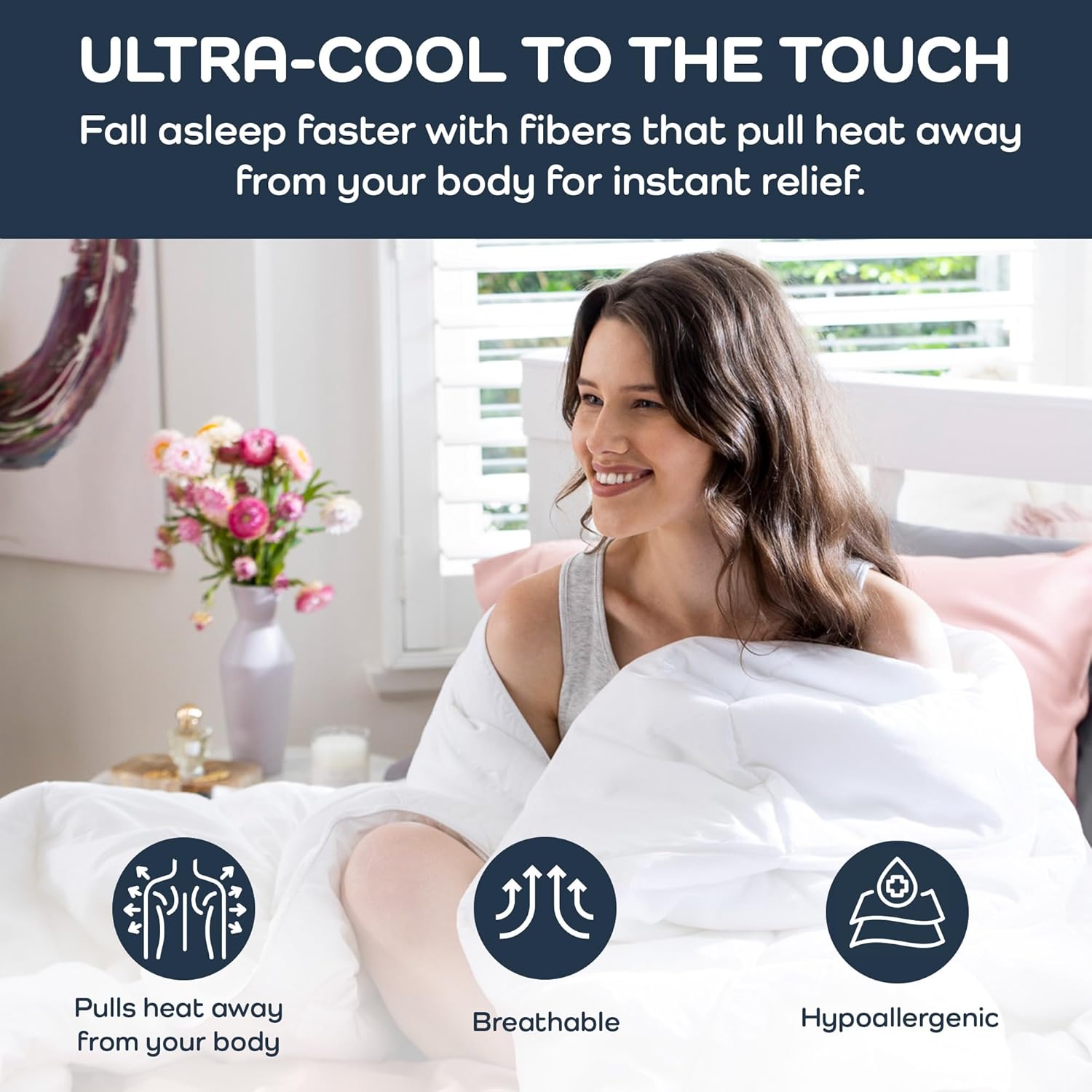
If you’ve been lying awake at 3 a.m. throwing off your comforter, you already know the problem. What you might not know is that the bedding market now offers three distinct engineering approaches to solving it — and they work in meaningfully different ways. A Q-Max score (short for qmax, a lab measurement of how quickly a fabric pulls heat away from skin on first contact) is printed on more and more comforter packaging, and numbers like 0.43 are being marketed as proof of cooling power. Bamboo-shell comforters promise breathability through fiber structure. Phase-change materials — think of them as microscopic wax beads woven into fabric that absorb body heat as they melt — claim sustained temperature regulation through the night. Before you spend $150–$400 on any of these, it’s worth understanding what each technology actually does, where it stops, and whether a plain lightweight down insert might solve your problem for less money.
| EDITOR'S PICKGlobon King Size Down Comforter… | Mid-tierGlobon Summer Down Comforter Bl… | Budget pickAPSMILE Lightweight Feather Dow… | |
|---|---|---|---|
| Size | King | Queen | Queen |
| Fill weight | — | 10 oz | — |
| Fill material | Down | Down | Feather down |
| Shell material | — | — | Organic cotton |
| Hot-sleeper claim | — | ✓ | ✓ |
| Corner tabs | 8 | — | — |
| Price | $162.99 | $119.99 | $79.90 |
| See on Amazon → | See on Amazon → | See on Amazon → |
What Q-Max Actually Measures — and What It Doesn’t
Q-Max is a standardized measurement of instantaneous thermal conductivity — specifically, how many watts per square centimeter a fabric transfers away from a warm surface in the first second of contact. The scale runs roughly from 0.10 (warm, slow-conducting — think thick fleece) to 0.50+ (very fast-conducting — think the cool side of the pillow, engineered). A score of 0.43 is genuinely high. Good Housekeeping’s 2024 overview of Q-Max in bedding notes that most conventional cotton shells score in the 0.15–0.20 range, so a 0.43 fabric really does feel dramatically cooler to the touch when you first pull it over you.
Here’s the tradeoff nobody puts on the box: Q-Max is a one-second measurement. It tells you nothing about what happens at minute 20, hour 3, or when your partner radiates heat from six inches away. The spec measures a fabric’s capacity to conduct heat away — but if you’re a chronic hot sleeper, you’re generating heat continuously, and eventually any fabric equilibrates to your body temperature. The “cool touch” sensation is real. The sustained thermoregulation claim is a separate, harder question that Q-Max doesn’t answer.
Owners of the Amélie Home Q-Max 0.43 comforter are instructive on this point. Across aggregated reviews, the pattern that emerges is not “I stayed cool all night” — it’s “I stopped waking up in a panic from overheating.” One buyer who describes waking up overheated throughout the night before the purchase says the product has been a lifesaver. A second buyer tested it layered directly over their existing all-season duvet specifically to solve a partner’s overheating problem and confirms it works even in that configuration. The mechanism is probably a combination of the cool-touch sensation reducing the perception of heat at sleep onset, plus a genuinely more conductive shell that allows a modestly higher rate of heat dissipation than standard polyester or cotton shells — not magic thermoregulation, but a real and meaningful improvement for people with a specific pain point.
The practical decision rule: If your problem is getting to sleep while hot, Q-Max is a legitimate spec to prioritize. If your problem is waking up soaked at 3 a.m. regardless of what you’re sleeping under, Q-Max alone won’t solve it, and you need to look at fill weight, airflow, and — for menopause-related night sweats — potentially a conversation with a clinician alongside your bedding choices.
Bamboo Shells: Real Breathability or Marketing Language?
Bamboo-derived fabric (usually sold as “bamboo viscose” or “bamboo rayon” — the fibers are chemically processed from bamboo pulp) is genuinely more moisture-wicking than standard polyester and performs comparably to or slightly better than cotton in breathability benchmarks. The Spruce’s 2025 comparison of bamboo versus cotton bedding notes that bamboo viscose’s fiber structure has a naturally porous cross-section that allows moisture vapor to pass through the fabric more readily, which matters when you’re sweating lightly rather than drenching the bed.
The key word is lightly. For buyers with mild heat sensitivity — the person who runs warm but doesn’t technically night-sweat — a bamboo-shell comforter with a lightweight fill is a well-matched solution. The Olive + Crate bamboo comforter surfaces an important secondary audience here: reviewers mention eczema and skin sensitivity as the deciding factor, not just temperature. Bamboo viscose tends to be softer and less irritating against skin than the tighter weave of a standard cotton percale shell, which means the breathability argument and the skin-sensitivity argument converge on the same product. If you’re shopping for a hot sleeper who also has reactive skin, bamboo shell is doing double duty in a way a high-Q-Max synthetic shell often can’t match.
What bamboo doesn’t do: It doesn’t provide active cooling. It’s a passive system — moisture moves through the shell more easily, which helps evaporative cooling work better, but the fabric itself isn’t pulling heat out of your body in the way a phase-change or high-Q-Max material does. It also doesn’t solve the fill equation. A bamboo-shell comforter with a heavy fill weight will still sleep warm; the shell is one variable, not the whole system.
Phase-Change Materials: The Most Ambitious Claim
Phase-change materials (PCMs) are the highest-concept cooling technology in the comforter category. The engineering logic is sound: certain compounds (typically paraffin-based microencapsulated beads) absorb a fixed quantity of heat energy as they transition from solid to liquid, theoretically creating a buffer against temperature spikes. The Sleep Foundation’s 2025 overview of cooling comforters notes that PCM-infused bedding has shown promise in controlled settings, particularly for reducing peak skin temperature in the first half of sleep.
The honest caveat: PCM performance degrades significantly in real-world conditions. The beads have a finite heat-absorption capacity per sleep cycle. Once they’ve fully transitioned to liquid, the cooling effect plateaus until the material re-solidifies (which happens when the ambient temperature drops — i.e., if you kick off the comforter or get up). For a hot sleeper in a climate-controlled bedroom set to 68°F, this is probably adequate. For a hot sleeper in a warm-climate home without air conditioning, the PCM may saturate faster than its marketing implies. There is, to be direct about it, very little independently published data on PCM performance in consumer bedding at the specific fill weights and encapsulation densities used in the $150–$300 price tier.
The tradeoff math:
| Technology | Mechanism | Effective window | Best for |
|---|---|---|---|
| High Q-Max (≥0.35) | Instantaneous heat conduction | Sleep onset, first contact | Getting to sleep while hot |
| Bamboo shell | Moisture vapor transmission | Sustained, passive | Mild heat + skin sensitivity |
| Phase-change (PCM) | Heat absorption buffer | First 2–4 hours | Peak temperature spikes |
No single technology covers the entire sleep cycle. The buyers who report the most consistent relief are those who combined the right technology with the right fill weight — which is where the case for a plain lightweight down insert becomes surprisingly competitive.
The Lightweight Down Alternative: Is Specialty Even Necessary?
This is the most interesting tension in the market. A buyer in Texas who resolved identical night-sweating problems with a standard lightweight down insert raises a fair challenge to the specialty-materials industry: if fill weight is the dominant variable, are you paying a premium for technology you don’t need?
The honest answer is: sometimes, yes. The APSMILE lightweight feather-down comforter reviewed by buyers who relocated from colder climates to warm ones frames the decision explicitly as a climate-adaptation problem — they didn’t suddenly become hot sleepers physiologically; they moved to a warmer climate and needed less insulation. For that buyer, a lighter fill is the correct diagnosis and the specialty-material premium adds nothing.
But a buyer with menopause-related night sweats — where, as Healthline’s 2024 overview of night sweats and menopause explains, the underlying mechanism is neurologically triggered vasodilation rather than ambient temperature — is dealing with a different physiology. Reducing fill weight helps (less insulation means less heat accumulation), but it doesn’t stop the triggering event. That buyer may genuinely benefit from a comforter that dissipates heat faster (high Q-Max) or manages moisture more effectively (bamboo viscose) — the specialty features are addressing a real mechanism, not just a comfort preference.
Decision rule:
- If you run warm but sleep in a warm room or warm climate → lightweight fill, any shell, is probably enough.
- If you run warm due to physiological heat generation (menopause, certain medications, metabolic factors) → specialty shell (high Q-Max or bamboo viscose) + lightweight fill is the correct pairing.
- If your problem is skin contact temperature at onset + sustained breathability → bamboo shell, moderate fill weight.
- If you want the highest-tech option and budget permits → PCM comforter in a temperature-controlled bedroom where the re-solidification cycle can complete.
Frequently Asked Questions
What does a Q-Max score of 0.43 actually mean in practical terms? It means the fabric transfers heat away from your skin roughly twice as fast as standard cotton on first contact. The sensation is noticeably cooler when you slide under it. It does not mean the comforter sustains that cooling rate all night — Q-Max is an instantaneous measurement, not a thermoregulation specification.
Does a cooling comforter work if I layer it over my existing duvet? Based on owner reports for the Amélie Home Q-Max comforter specifically, yes — buyers who layered it over an all-season duvet for a partner’s overheating problem report that it works in that configuration. The logic: the Q-Max shell is doing its heat-conduction work at the skin-contact layer regardless of what’s underneath. That said, layering adds total insulation, so fill weight of the underlying duvet matters.
Is bamboo genuinely more breathable than cotton as a comforter shell? The answer from material science is a qualified yes. Bamboo viscose’s fiber cross-section allows moisture vapor to pass through more readily than most cotton weaves, per The Spruce’s 2025 comparison. The practical difference is noticeable for light sweaters; for heavy night sweaters, no shell fabric alone is adequate.
Can a lightweight down insert solve the same problem as a specialty cooling comforter? For climate-adaptation hot sleepers (you moved somewhere warmer, or your household thermostat changed), often yes — fill weight reduction is the primary lever. For physiological hot sleepers (menopause, metabolic, medication-related), fill weight helps but specialty shell technology addresses mechanisms that fill weight alone doesn’t.
Are cooling comforters effective for menopause-related night sweats specifically? They can reduce the severity and recovery time of episodes. Healthline’s overview of menopause-related night sweats is explicit that the triggering mechanism is neurological, not environmental — so no bedding eliminates the cause. High-Q-Max and bamboo-viscose shells help by dissipating heat faster once an episode starts, which reviewers consistently describe as reducing how long they stay awake after waking.
Does the Amélie Home dual-sided design mean one side is warmer and one cooler? Based on published product descriptions and owner reviews, yes — the dual-sided construction pairs a high-Q-Max cooling face with a standard-feel reverse side, giving sleepers the option to flip based on preference or season. Owners report using the cooling side in summer and the standard side in shoulder-season months, which effectively doubles the product’s useful calendar.
The bottom line is that specialty cooling comforters do work — within the specific mechanisms they’re engineered for. Q-Max delivers at sleep onset. Bamboo delivers passive breathability across the night. Phase-change materials deliver a heat buffer in the first sleep cycle. None of them is a substitute for matching fill weight to your actual thermal environment, and none of them eliminates the underlying causes of menopause-related night sweats. Know which problem you’re solving, match the technology to that problem, and the specs will earn their premium. Buy the wrong category of cooling and you’ve spent real money on a sensation that fades by midnight.