August 6, 2026 • Margot Calloway • 11 min reading time • Prices verified June 4, 2026
Couples With Different Sleep Temperatures: The Comforter Strategy That Actually Works
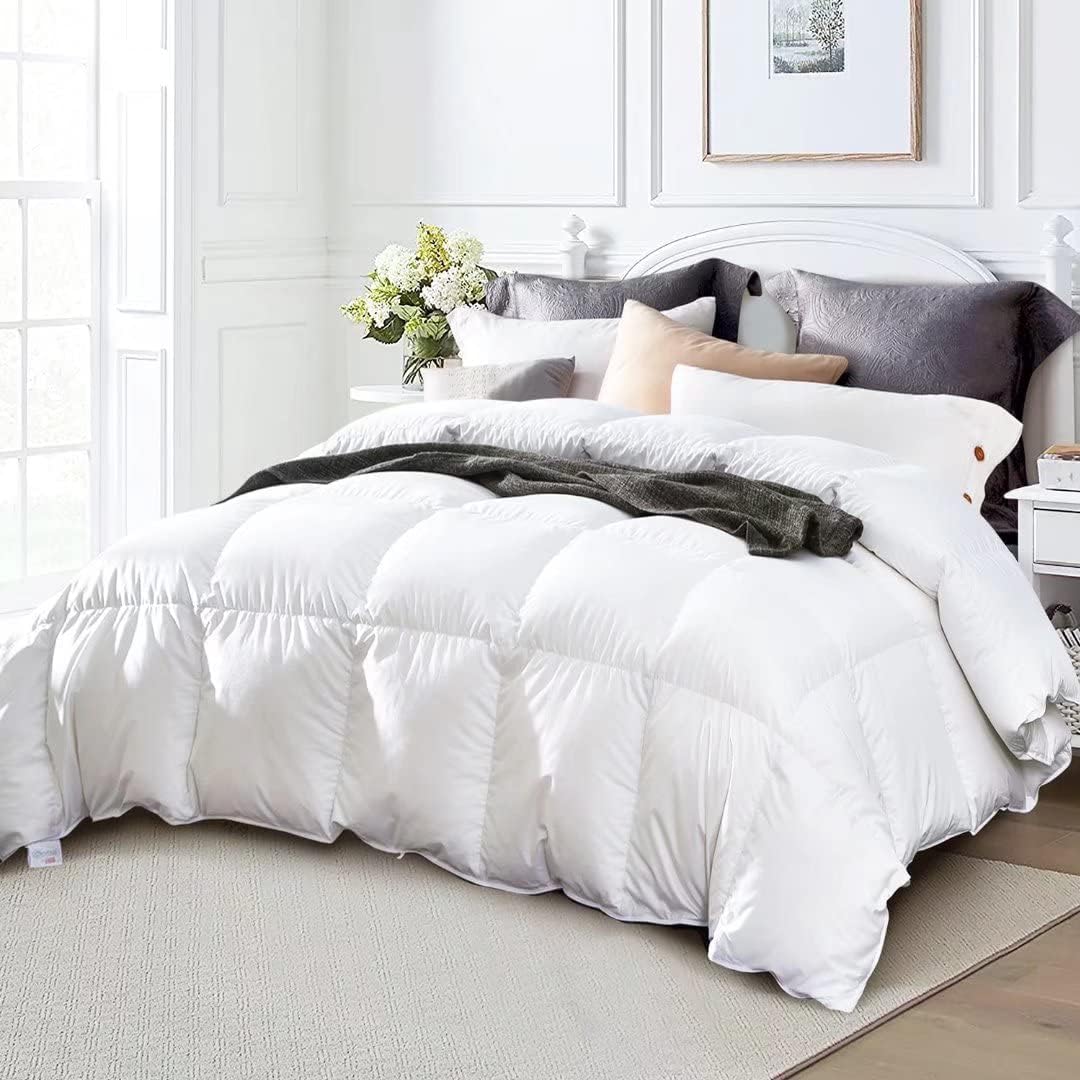
If you and your partner have ever silently waged a tug-of-war over the blanket at 2 a.m., you already understand the core problem. One of you is radiating heat; the other is curled into a ball trying to hoard warmth. A comforter — the thick, quilted blanket that sits on top of your bed and does most of the thermal work — is rated for a range of temperatures and filled to a specific warmth level. The trouble is, that rating is one number, and you are two people with genuinely different internal thermostats. This guide walks through every real solution, ranked by how well it holds up in practice: from single-comforter compromises all the way to the two-duvet method that most of Europe considers completely normal and that a growing number of American couples are quietly adopting. By the end, you’ll have a clear decision framework — not a hedge.
Why “Just Buy a Medium-Weight Comforter” Usually Fails
The instinct is reasonable: meet in the middle. Buy an all-season fill weight — typically 30–50 oz of fill for a king — and hope both partners are comfortable. For couples whose temperature preferences are mildly different, this sometimes works. But “all-season” is a marketing phrase that describes a statistical average, not a physiological match. The Sleep Foundation’s overview of hot-sleeper comforters notes that body temperature regulation during sleep varies significantly by individual, and that a fill weight calibrated for a neutral sleeper will still overheat someone who runs warm, while leaving a cold sleeper under-covered.
Verified buyer reviews reinforce this pattern. A reviewer of the Globon King comforter describes the exact scenario: she runs cold, her husband runs hot, and they tried the comforter together at a 68-degree room temperature. The outcome was a qualified success — but it required that specific room temperature as a control variable. Another Globon reviewer solved a related problem by layering the insert between a comforter and a bedspread to address her husband’s cold-leg problem specifically — an improvised solution to a mismatched coverage need. These are not outliers. They are the modal couple in this category.
The thermal mismatch problem breaks into two distinct scenarios:
- One hot sleeper, one cold sleeper sharing the same bed surface — the classic case, where any single fill weight is a compromise.
- One partner with cold extremities but a warm core — more common than people realize, and solvable with layering rather than a different fill weight.
Scenario 2 is easier. Scenario 1 is the one that drives people to Reddit at midnight.
The Scandinavian Two-Duvet Method: What It Is and Why It Works
In Denmark, Norway, Sweden, and much of Germany, a couple sharing a bed uses two separate duvets — typically two twin-sized inserts on a king or queen-sized bed frame. Each person controls their own thermal environment entirely. There is no negotiation, no tug-of-war, no compromise fill weight. Apartment Therapy’s explainer on the Scandinavian sleep method notes that this practice is so standard in Scandinavian households that a hotel offering a single shared duvet to a couple would read as unusual.
In the United States, it remains underused — often perceived as a sign of relationship trouble rather than a straightforward ergonomic solution. That framing is worth discarding. The method is already being adopted independently by couples who stumble into it: a verified buyer of the APSMILE Lightweight comforter explicitly reviewed the product to note they are running two queen-sized inserts on a king bed — a direct, real-world implementation of the two-duvet approach. They did not call it the Scandinavian method. They just solved the problem.
How to Execute the Two-Duvet Method on a King Bed
The geometry matters. A standard king bed is 76 inches wide. Here are your three options:
| Insert configuration | Width coverage | Notes |
|---|---|---|
| Two twin XL inserts (38” each) | 76” total — exact fit | Cleanest option; no overlap, no gap |
| Two full/queen inserts (60” each) | 120” total — 44” overlap | Most common improvised approach; each partner gets full coverage + tuck room |
| One king + one twin XL | 76” + 38” = asymmetric | Works if one partner needs significantly more coverage |
The most common real-world choice, based on aggregated reviewer commentary, is two queen inserts on a king — each person gets a generous 60 inches of coverage with room to wrap. The 44 inches of overlap in the middle is hidden under the top sheet or duvet covers and is functionally irrelevant at night when each person pulls their own insert toward themselves.
The practical numbers:
- Two twin XL inserts: ~$120–$280 for mid-market fills; ~$400–$900 for premium goose down at 700–800 fill power
- Two queen inserts: ~$140–$320 mid-market; ~$500–$1,100 premium tier
- Add two duvet covers: budget an additional $60–$200 per cover depending on shell quality
Single-Comforter Options That Genuinely Narrow the Gap
If the two-duvet approach isn’t right for your household — aesthetics, budget, or preference — there are single-comforter strategies with real evidence behind them.
Cooling Comforters Designed for the Hot Sleeper
A verified buyer of the Amélie Home cooling comforter documented an explicit side-by-side test with her hot-sleeping husband, comparing it against their existing all-season duvet. The reviewer’s framing was direct: the cooling comforter worked for the hot sleeper without leaving her cold. Good Housekeeping’s roundup of cooling comforters identifies the key spec to look for: fill materials with lower thermal resistance — down-alternative fills with open-weave shells, or down with a percale shell rather than a sateen shell. Sateen traps more heat; percale breathes.
The mechanism isn’t magic. A cooling comforter reduces the peak temperature experienced by the hot sleeper. It does not actively refrigerate a cold sleeper’s side. If your cold sleeper runs genuinely cold — not just slightly cool — a cooling comforter will make them uncomfortable. This is the tradeoff to name explicitly before purchase.
The “Layering” Fix for Cold Extremities
The Globon reviewer who layered the insert between a comforter and a bedspread had identified something real: a second thin layer at the foot of the bed addresses cold legs without raising the overall fill weight of the sleep surface. This is worth distinguishing from the two-duvet method. It’s not a full split — it’s a targeted thermal patch for one partner. The cost is low (a lightweight throw or a thin down-alternative blanket), the aesthetic impact is minimal if chosen carefully, and it preserves the shared-comforter dynamic for couples who want it.
High Fill Power + Baffle-Box Construction
Wirecutter’s long-running guide on the best down comforters makes a useful point about fill power and thermal efficiency that applies here: higher fill power (800+) means more loft per ounce of fill. A 800-fill-power comforter can be built at a lower fill weight than a 600-fill-power product and achieve the same warmth. For couples where the gap is moderate — say, one person runs slightly warm — a premium comforter at lower fill weight is a more precise tool than a budget comforter padded to the same warmth. A verified buyer of the puredown 800-fill-power comforter noted it works for both partners despite one running hot — precisely because 800 fill power at a moderate fill weight lands in a narrower thermal band than a heavier, lower-power fill.
Baffle-box construction — where internal fabric walls create three-dimensional pockets that hold fill in place — keeps fill distributed evenly, so neither partner is sleeping under a cold patch where fill has shifted. Sewn-through construction (where the top and bottom shell layers are stitched directly together, creating flat seams) creates cold channels and is less forgiving for couples because uneven fill distribution affects one side more than the other.
Making the Bed Look Intentional With Two Comforters
This is the objection that stops most couples from trying the two-duvet method. It doesn’t have to look chaotic. A few approaches that work, based on the editorial styling logic found across Architectural Digest and Apartment Therapy’s bedding guides:
Option 1 — The hotel fold. Make the bed each morning by laying both inserts flat and folding the top third down together, as if they were one piece. At reading distance, the seam is invisible.
Option 2 — The matching duvet cover. Buy two identical duvet covers. From across the room, the bed reads as a single made surface. The split is only visible on close inspection.
Option 3 — Embrace the layered aesthetic. Style the two comforters in complementary but intentionally different covers — a pattern on one side, a solid on the other. This reads as editorial rather than accidental, and it’s a legitimate bedroom styling move.
Option 4 — A top sheet as visual anchor. A flat top sheet tucked across the full width of the bed, with both inserts on top, creates a unified base layer that visually ties the bed together even if each partner’s insert is different.
Frequently Asked Questions
Can two people with different temperature preferences share one comforter? Yes, with caveats. If the temperature difference is moderate — one partner sleeps slightly warm, the other slightly cool — a lightweight or cooling comforter at low fill weight can work for both. If the gap is large (one partner is consistently too hot in any shared comforter, the other is consistently cold), a single comforter is genuinely a compromise, not a solution. The two-duvet method is a better fit.
What is the Scandinavian two-duvet method and does it actually work? It is a standard European practice in which each bed partner uses their own duvet (comforter) rather than sharing one. It works because it removes the thermal negotiation entirely — each person controls their own warmth. Apartment Therapy’s coverage of the method confirms it’s gaining traction in the US. Reviewer evidence from APSMILE buyers shows couples already doing it independently.
Do I need to buy two twin inserts or two queen inserts for a king bed? Either works. Two twin XL inserts give a cleaner, zero-overlap coverage (76 inches total on a 76-inch-wide king). Two queen inserts give each partner 60 inches of coverage with significant overlap in the center — more wrapping room, slightly messier geometry. Two queens is the more common improvised choice based on what’s available at mid-market price points.
Will a cooling comforter on one side of the bed affect the warm sleeper on the other side? No. A comforter sits on top of the person using it; it does not actively cool the air or the mattress surface in a way that affects the other side. A cold sleeper on the other half of the bed will experience the comforter they are sleeping under — not the cooling comforter next to them.
Is there any comforter that genuinely works for both a hot and cold sleeper? The honest answer is: sometimes, under specific conditions. The Globon King worked for one cold-running and one hot-running reviewer at a 68-degree room temperature. The puredown 800-fill-power worked across a moderate temperature mismatch. But “works for both” always means “acceptable compromise for both,” not “optimal for either.” If both partners need to sleep well — rather than just tolerably — two inserts is the more reliable system.
How do you make a bed look neat when using two separate comforters? Use matching duvet covers, fold both inserts down together in the morning as a single layer, or anchor the visual with a top sheet underneath both. The Scandinavian interior design tradition has been managing this aesthetic question for generations — the bed can look as intentional as any single-comforter setup with minimal effort.
The Decision Rule
If your temperature gap is small and your priority is simplicity: a lightweight down or down-alternative comforter at 700–800 fill power with a percale shell is your best single-comforter bet. Match the fill weight to the hot sleeper, not the cold sleeper — it is easier to add a layer for the cold partner than to cool down the hot one.
If your temperature gap is large and both partners need to sleep well: run two inserts. Two queen inserts on a king bed is the lowest-friction implementation. The upfront cost is real; the nightly quality-of-sleep return justifies it. The Responsible Down Standard (responsibledown.org) certifies ethical sourcing at every price tier — you don’t have to spend premium to buy responsibly.
If aesthetics are the barrier: two matching duvet covers and a morning fold routine make the setup invisible to guests. The bed looks like every other well-made bed in the room.