September 29, 2026 • Margot Calloway • 11 min reading time • Prices verified June 4, 2026
The 'Hotel Bed Feel' Buyers Keep Chasing: Which Down Inserts Actually Deliver It

Every year, thousands of people walk out of a hotel, strip the brand tag off their memory of that bed, and spend the next six months trying to recreate it. The comforter — billowing, crisp at the edges, impossibly soft against skin — is almost always central to that memory. A down comforter is simply a blanket filled with the soft, fluffy plumage (called “down clusters”) found under a bird’s outer feathers. The clusters trap air and create warmth without weight. “Fill power” measures how much space one ounce of down expands to fill — higher numbers mean a loftier, lighter comforter. “Fill weight” is the total number of ounces of down packed inside a finished comforter — a separate spec that controls total volume. That’s the whole vocabulary you need to follow this article. What the reviews make clear, though, is that fill power tells only half the story of the hotel bed feel. The other half is more nuanced — and understanding it is the difference between buying a comforter that looks like a hotel bed and one that actually feels like it.
| EDITOR'S PICKLuxurious King/Oversized King 1… | Mid-tierSerta Goose Feather Down Fiber… | Budget pickSerta Goose Feather Down Fiber… | |
|---|---|---|---|
| Size | King/Oversized King | King | Queen |
| Dimensions | 108" x 98" | 106 x 90 in | 90 x 90 in |
| Fill | Goose down + feather | Goose feather down | Goose feather down |
| Cover | Egyptian cotton | 100% cotton | 100% cotton |
| Fill weight | 65 oz. | — | — |
| Warmth | — | Light | Medium / all-season |
| Price | $169.95 | $85.79 | $63.98 |
| See on Amazon → | See on Amazon → | See on Amazon → |
The Two Things Buyers Actually Mean by “Hotel Feel”
Spend time with aggregated buyer reviews across LOVSOUL, Bedsure, Martha Stewart’s Amazon line, Serta, and APSMILE inserts, and a pattern surfaces almost immediately: buyers are describing two distinct sensory experiences and labeling both “hotel feel.”
Experience one: Visual loft. This is the puffed-up, architectural look from across the room. The comforter stands away from the mattress, holds its shape, and reads as a design element — not just a blanket. Reviewers consistently use phrases like “hotel-like look,” “it makes the whole room,” and “crispness” when describing this. A taut, structured shell and adequate fill weight — the total amount of down packed inside, separate from fill power — are what create that across-the-room impression.
Experience two: Skin-contact softness. This is the moment buyers describe as “hopping into bed” — when the comforter meets your body. Reviewers in this camp often mention warmth without heaviness, a drape that contours rather than sits stiff, and softness at the shell level. One Bedsure oversized-king buyer who spent two years searching for the hotel feel articulated it precisely: she wanted “the luxury softness but a little less heavy.” She had apparently tried hotel-weight options and found them too warm — meaning the weight associated with visual loft was working against her skin-contact experience.
This tension matters practically. Products that maximize visual loft tend to use higher fill weight and a structured baffle-box construction — the comforter is divided into sewn fabric boxes that keep down from shifting, allowing it to fully expand. Products that maximize skin-contact softness often use lighter fill weights, pre-washed shells, and softer shell fabrics like sateen or brushed cotton. Rarely does one insert nail both out of the box, and understanding which experience you’re chasing is the first real decision.
Fill Power vs. Fill Weight: Show the Math
Most buyers arrive knowing fill power. Fewer arrive knowing fill weight, even though weight is often the more decisive variable for the hotel feel.
By the numbers:
- A typical economy hotel comforter: 400–550 fill power, 30–40 oz fill weight (queen)
- A typical upscale hotel comforter: 550–650 fill power, 28–36 oz fill weight (queen)
- A luxury property flagship: 650–800 fill power, 22–30 oz fill weight (queen) — less weight because higher fill-power clusters expand more efficiently
The math: a 550 fill-power insert needs more ounces of down to achieve the same loft as an 800 fill-power insert. Hotels don’t universally use the highest fill power — many use mid-range fill power at a generous fill weight to create durable, laundry-resistant volume that holds up across hundreds of wash cycles. Wirecutter’s review of the best down comforter category notes that most hotel-sourced inserts cluster between 500 and 650 fill power, not the 800-plus tier that luxury residential buyers often target.
The practical consequence: if you buy a 750 fill-power insert at a modest fill weight to keep costs reasonable, you may get a lighter, airier result than the hotel reference point you remember — which was likely a heavier, denser fill at moderate fill power. Real Simple’s best down comforters roundup flags fill weight as an underrated spec, noting that buyers fixated on fill power alone often under-buy and end up with inserts that look flat in person. The Sleep Foundation’s best down comforters guide echoes this, recommending that buyers consider their climate and typical room temperature alongside both fill power and fill weight before purchasing.
Why Your Insert Looks Flat (Even With High Fill Power)
This is the most common disappointment pattern in the review corpus, and it has four culprits:
1. Underfill for the shell size. Many budget inserts use the same fill weight across multiple sizes and simply extend the shell dimensions. A king insert with a queen’s fill weight will look sparse at the edges — the exact opposite of the hotel puff that drapes generously over the mattress.
2. Sewn-through construction instead of baffle-box. In a sewn-through comforter, the top and bottom shell layers are stitched directly together to form the fill pockets. Those stitched seams create cold spots and prevent full cluster expansion. Baffle-box construction adds a fabric “wall” between the top and bottom panels, letting clusters expand in three dimensions. Good Housekeeping’s best down comforters testing consistently identifies baffle-box construction as the standard associated with hotel-style loft.
3. Down needs time to re-loft after compression. New inserts arrive compressed from packaging and may look alarmingly flat. Owners consistently report that a 24–48 hour low-heat tumble dry, or simply leaving the insert to air out for a full day, restores full loft. If you’re judging your insert immediately out of the box, give it time.
4. The duvet cover is fighting the insert. A tight-weave duvet cover with a small opening compresses an insert before it even gets to perform. More on this below.
The System Problem: Why Pairing Matters as Much as the Insert
Among all the review patterns in this category, buyers who pair a quality insert with bamboo or high-thread-count cotton sheets — and credit the combination rather than any single product — are demonstrating unusually accurate intuition. The hotel bed feel is a system result, not a product result.
Apartment Therapy’s guide “How to Make Your Bed Look Like a Hotel Bed” identifies layering order and component pairing as equally important to any single product’s specs. Hotels typically use a specific protocol: a fitted sheet with deep pockets that doesn’t bunch, a flat sheet between sleeper and comforter (which also protects the down insert from body oils and reduces wash frequency), a duvet cover with interior corner ties, and an insert that is one size up from the bed. A king insert on a queen bed, for example, creates the overhang-and-drape that reads as luxurious.
The duvet cover fabric matters more than most buyers anticipate. A stiff, low-thread-count polyester cover will muffle even a premium insert’s softness. A 300-plus thread count percale or sateen cotton cover transmits the softness of what’s inside. This is why reviewers who self-describe as “linen snobs” tend to rate mid-tier inserts highly — they’re pairing them with quality linens that let the insert express itself fully.
Comparing the Field: Which Insert Fits Which Buyer
The three tiers below map to meaningfully different price points and use cases. Each represents a different optimization within the hotel-feel target.
Budget Tier: Bedsure and LOVSOUL Inserts
Both Bedsure and LOVSOUL draw buyers who are explicitly chasing the hotel reference point at an accessible price. Bedsure’s oversized king format — which adds several inches of overhang on all sides — is its primary differentiator at this tier. That extra fabric creates the drape that reads as luxurious from across the room, compensating for fill weight that is modest compared to mid-tier options. LOVSOUL’s pre-washed shell is its equivalent differentiator: reviewers consistently describe it as unusually soft for the price, with the skin-contact softness arriving immediately rather than requiring break-in time.
Neither insert is a substitute for a higher-fill-weight option if your primary goal is visual loft. But for buyers prioritizing skin-contact experience and working within a tight budget, both over-deliver relative to their price. The two-year-search Bedsure buyer’s verdict — “luxury softness, a little less heavy” — is the right frame for this tier.
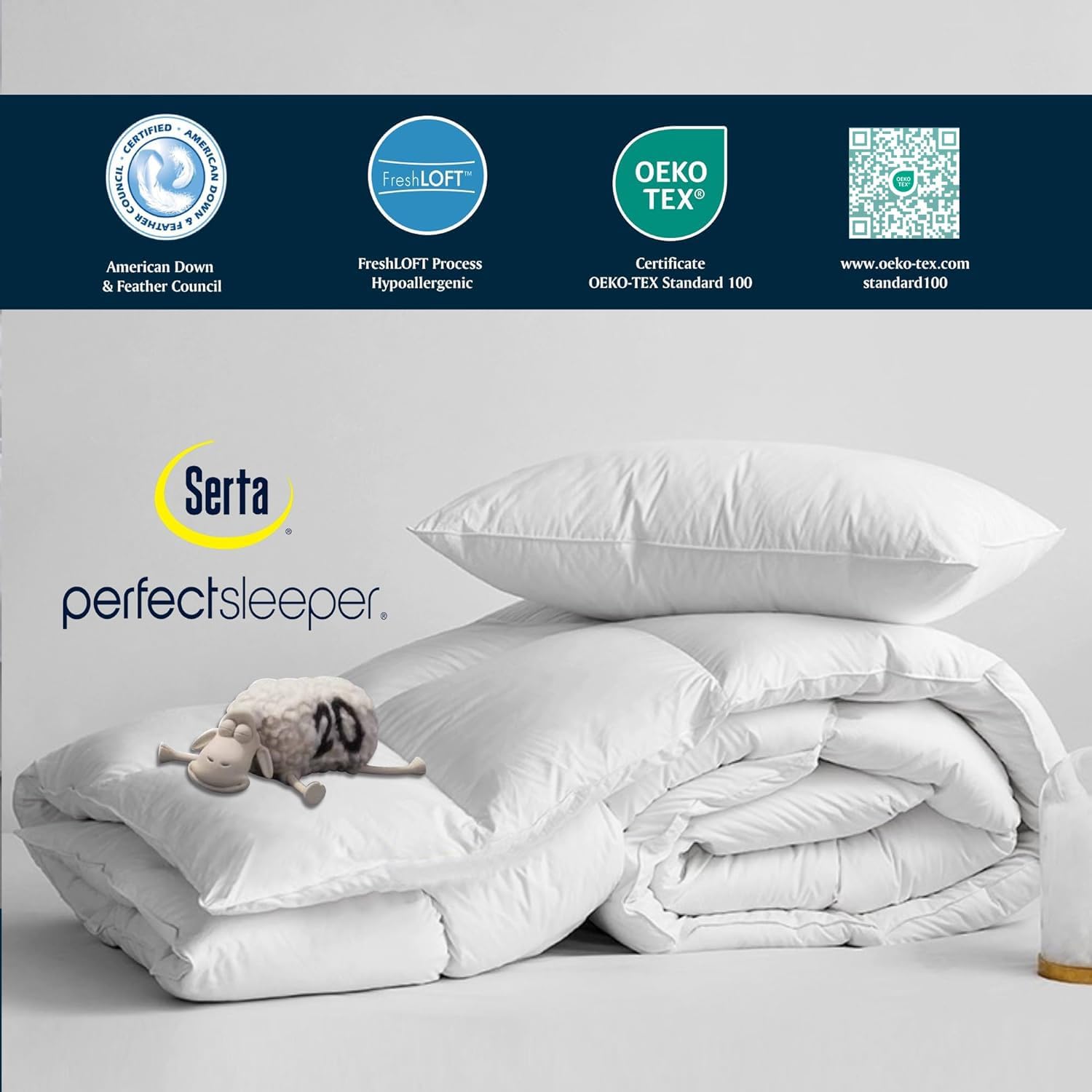
Serta
$63.98
In stock on Amazon
Check price on AmazonMid-Tier: Martha Stewart Amazon Line vs. Serta Queen Insert
Both inserts appear in the same approximate price corridor and draw buyers chasing the hotel benchmark. They optimize for different halves of it.
Martha Stewart’s Amazon down insert draws reviewers who emphasize skin-contact softness and shell quality. The “well-made, looks more expensive than it is” verdict from a self-described linen snob — who returned it but still recommended it — is high-signal: it means the construction quality read correctly to a discerning buyer even when fit wasn’t right for her specific setup. The return itself shouldn’t be read as a product failure; she flagged warmth or sizing, not quality.
Serta’s queen insert draws reviewers who emphasize the visual side of the hotel feel — specifically the cotton cover’s breathability and the maintained loft over time. The “hotel-like look” framing appears across multiple independent reviews of Serta’s insert, suggesting it performs well on the across-the-room metric.
The decision rule at this tier: if you run warm or sleep in a room above 68°F, Martha Stewart’s lighter, softer profile is the better fit. If you’re optimizing for the visual architecture of the bed — the puff, the drape, the crisp made-bed look — Serta’s cotton-shell construction holds its structure better for that purpose.
Serta
$85.79
In stock on Amazon
Check price on AmazonPremium Tier: APSMILE and High Fill-Power Baffle-Box Options
APSMILE buyers who pair the insert with bamboo sheets and credit the combination are getting the most out of the premium tier. At this price point, baffle-box construction is non-negotiable — and APSMILE delivers it alongside a fill power that sits in the 600-plus range, which aligns more closely with the upscale hotel sourcing profile described above than with the ultra-light 800-plus tier that prioritizes weight savings over the dense, structured loft that hotel beds are known for.
The premium tier is also where ethical sourcing credentials become part of the value equation. The Responsible Down Standard, administered through responsibledown.org, certifies that down is sourced without live-plucking or force-feeding. Buyers at this price point increasingly treat RDS certification as a baseline rather than a differentiator — and APSMILE’s certification status is worth confirming at point of purchase. Good Housekeeping’s tested comforters roundup specifically calls out RDS and similar certifications as meaningful signals of supply-chain accountability at the premium tier.
Luxurious
$169.95
In stock on Amazon
Check price on AmazonFrequently Asked Questions
Do I need a specific duvet cover to get the hotel bed look at home? Yes, cover choice matters significantly. A cover made from percale or sateen cotton at 300-plus thread count with interior corner ties and a large, accessible opening will let your insert fully expand and stay centered. A cover that’s too tight compresses the insert. Hotels almost universally use white covers with a tight but flexible weave — the visual crispness you remember is partly the cover, not just the fill.
Is the hotel feel more about fill weight or fill power? Based on how hotels actually spec their inserts — typically 500–650 fill power with generous fill weight — fill weight is the underrated variable. Fill power tells you how efficiently the down uses space. Fill weight tells you how much volume you actually end up with. Wirecutter’s best down comforter review and Real Simple’s best down comforters roundup both flag this distinction as the most common source of buyer disappointment.
Why does my comforter look flat even though I bought a high fill-power insert? Most likely one of four things: the insert needs 24–48 hours to fully re-loft after compression shipping; the construction is sewn-through rather than baffle-box; the insert is the same size as your bed rather than one size up; or the duvet cover is suppressing expansion. Try a low-heat tumble dry cycle first — it’s the fastest fix.
Will a baffle-box insert maintain its hotel-style puff after multiple washes? Better than sewn-through, yes. Baffle-box construction keeps down distributed across individual chambers even after washing. The key is wash protocol: low heat, gentle cycle, and a 60–90 minute low-heat dry with two or three clean tennis balls to break up clumping. Owners who skip the dryer step consistently report flat results on the first wash that they mistakenly attribute to quality degradation.
What fill power do most hotel comforters use? The Sleep Foundation’s best down comforters guide and Wirecutter’s comforter coverage both place most hotel-tier inserts in the 500–650 fill power range — not the 800-plus tier that luxury residential buyers often target. The priority in hotel purchasing is durability across repeated commercial laundering cycles, not the highest possible loft-per-ounce efficiency. That’s why the hotel reference feel is achievable at mid-market fill power with the right fill weight and construction.