September 8, 2026 • Margot Calloway • 10 min reading time • Prices verified June 4, 2026
Buying a King or Oversized King Insert for a Queen Bed: What Owners Actually Report
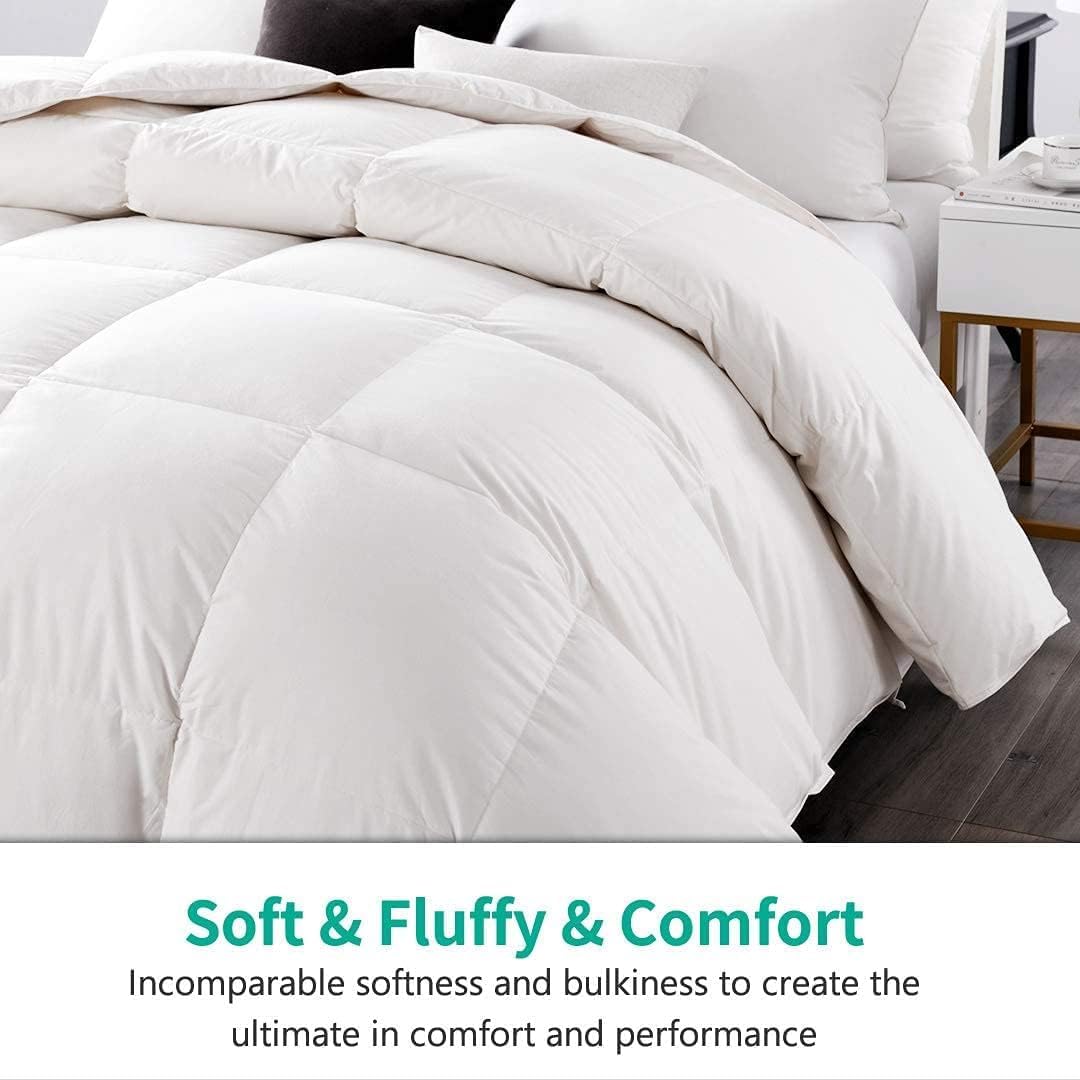
A comforter insert is the quilted, fill-stuffed panel that goes inside a duvet cover — or gets used bare, straight on the bed. Its dimensions are listed in inches (width × length), and most inserts come in sizes that roughly mirror mattress sizes: twin, full/queen, king, and California king. A standard queen insert runs approximately 88×88 inches. A standard king insert runs approximately 104×88 inches. An oversized king — sometimes labeled “super king” or listed at 108×98, 110×96, or even 120×98 — adds even more material in both directions. The question this article answers: what actually happens when a queen-bed owner skips the queen insert and buys a king or oversized king instead? Owners across a wide range of brands have discovered this strategy — sometimes deliberately, sometimes by accident — and their reports reveal a consistent pattern of benefits and one significant trap that almost nobody warns you about before you buy.
If you already know fill power, baffle boxes, and thread-count trade-offs, you’re ready for the practitioner-level detail below. Let’s get into it.
| EDITOR'S PICKAPSMILE Oversized King Size Dow… | Mid-tierAmélie Home Cooling Comforter K… | Budget pickUtopia Bedding Full Comforter D… | |
|---|---|---|---|
| Size | Oversized King | King | Full |
| Dimensions | 120x98 in | 106x90 in | 82x86 in |
| Fill Material | Down feather fibers | — | Down alternative |
| Cover Material | 100% Organic cotton | — | — |
| Cooling Feature | — | ✓ (Q-Max 0.43) | — |
| Corner Tabs | — | — | ✓ |
| Price | $169.00 | $89.99 | $28.99 |
| See on Amazon → | See on Amazon → | See on Amazon → |
Why Owners Are Sizing Up in the First Place
The impulse to go bigger than “recommended” shows up across countless reviews — and the reasons cluster into three distinct motivations.
The cover-steal problem. Two sleepers under one insert will always negotiate warmth at some level, but a queen insert on a queen bed leaves almost no margin. Owners report that a standard queen insert — at 88 inches wide across a 60-inch mattress — yields roughly 14 inches of drop on each side. That sounds adequate until one person rolls over and the whole panel shifts. A standard king at 104 inches wide adds 16 inches of total width, distributing about 8 extra inches of drape per side. Real Simple’s sizing guide notes that many couples deliberately choose a king insert for a queen bed for exactly this reason: more width means the insert can travel a few inches without either sleeper losing coverage.
The frame-coverage problem. Several owners of tall platform frames, sleigh beds, or high box-spring setups report that standard-sized inserts simply don’t reach the floor visually — the box spring is exposed, the bed looks underdressed. One pattern across reviews of taller-frame setups: buyers who switched to an oversized king specifically because “regular king comforters never fully cover the box spring,” as one CozyLux reviewer put it. The extra length in an oversized king (often 98 inches versus the standard 88) addresses drop from the footboard as much as it addresses side drop.
The aesthetic problem. The “hotel bed” look that drives so much bedding aspiration relies on a specific proportion — generous overhang, a full, billowy presentation, nothing pinched or mean-looking at the edges. Apartment Therapy’s bed-styling guides consistently emphasize that an oversized insert is one of the simplest ways to achieve that look without expensive furniture. Owners confirm this in the language of their reviews: one DOWNCOOL oversized king reviewer reports it “completely transformed the look” of their bed, unprompted by any styling question. An APSMILE oversized king buyer notes that the oversized fit “drapes beautifully over the sides” — they were fitting a California king, a bed notoriously hard to source for, but the same geometry applies on a queen.
The Numbers: Queen Bed, King Insert, Real Overhang
Here’s the practical math, grounded in published dimensions from Sleep Foundation’s mattress sizing reference.
| Insert size | Nominal width | Queen mattress (60”) | Side drop each side |
|---|---|---|---|
| Standard queen | 88” | 60” | ~14” per side |
| Standard king | 104” | 60” | ~22” per side |
| Oversized king (108”) | 108” | 60” | ~24” per side |
| Oversized king (120”) | 120” | 60” | ~30” per side |
At 22 inches of drop per side, a standard king insert on a queen bed is generous by any hotel standard. At 30 inches, you’re approaching floor-length drape on a standard-height frame — intentional for some buyers, extreme for others. The length dimension matters too: a standard king insert is typically 88 inches long (same as queen), but many oversized kings run 96–98 inches, giving extra drop at the footboard.
The Trap Everyone Misses: The Duvet Cover Mismatch
This is the part of the decision that almost never appears in reviews — which is itself the warning.
A duvet cover is essentially a giant pillowcase for your insert. You stuff the insert in, button or tie the open end closed, and wash the cover instead of the insert. Covers are sold in the same nominal sizes as inserts: twin, queen, king.
Here’s the problem: a king insert does not fit cleanly inside a queen duvet cover. The insert is 104 inches wide; the queen cover’s interior is roughly 88–90 inches wide. You can force it in, but the insert will bunch, bunch again every time you wash it, and never lie flat. The result is the exact lumpy presentation you were trying to escape.
The inverse option — using a king duvet cover on a queen bed — solves the insert-fit problem but creates its own: the cover will be oversized on the bed, with excess fabric at the edges pooling or folding over. Depending on your aesthetic, that can actually look intentional (relaxed, European hotel), or it can look sloppy.
What the reviews actually reveal: across the owner accounts that informed this piece, buyers appear to be doing one of three things — (1) using the insert bare, without any cover at all, (2) purchasing a matching oversized cover sold as a set, or (3) simply not mentioning cover logistics at all, which suggests they haven’t encountered the mismatch yet or don’t use a cover. Good Housekeeping’s comforter coverage notes that buyers often conflate “comforter” (intended to be used bare) with “duvet insert” (intended to live inside a cover), and that misunderstanding drives a lot of post-purchase confusion.
The practical decision rule: If you want to size up your insert, decide your cover strategy before you buy the insert — not after. If you’re going bare (no cover), sizing up is almost entirely upside. If you use a cover, you need to source a king or oversized king cover simultaneously. Don’t assume you’ll find one later; not every cover ships in oversized dimensions, and matching a specific insert’s dimensions to a compatible cover can take more searching than buyers expect.
Does Sizing Up Actually Help With Partner Cover-Stealing?
Honestly, partially — but not as completely as buyers hope.
More width means the insert can shift without one person losing it entirely. That is a real benefit. But the root physics of cover-stealing — one person rolling toward the center while the other is on the edge — aren’t solved by width alone. The insert can still be pulled, it just has more slack before someone’s exposed.
What does help more: corner tabs. Most quality inserts above the entry tier include sewn-in corner ties. If your duvet cover also has interior corner loops (many mid-market and premium covers do), you anchor the insert at all four corners, and it can’t travel more than a few inches regardless of size. The Spruce’s duvet-care guide notes that tab-anchored inserts stay centered through even active sleeping far better than unanchored ones. If cover-stealing is your primary motivation for sizing up, anchoring a correctly-matched insert is probably a better fix than simply buying bigger.
Oversized King vs. Standard King: Does the Size Difference Matter for a Queen Bed?
If you’re already going king on a queen bed, is the oversized king meaningfully better?
It depends on what you’re optimizing for.
-
For aesthetic drape: An oversized king at 108×98 adds about 2 inches of drop per side over a standard king, and 10 inches of extra length at the footboard. On a standard-height frame, that’s noticeable but not dramatic. At 120×98, the difference is significant — you’re looking at floor-grazing drape on many frames.
-
For cover-steal prevention: The extra 4–16 inches of width over a standard king adds marginally more slack. It’s probably not the deciding factor.
-
For the California king problem: An oversized king is specifically engineered to solve the California king’s unusual proportions (72” wide × 84” long). On a queen, that extra width is simply more overhang — which you may or may not want.
The clearest case for oversized over standard king: tall-frame beds where footboard coverage is the issue, and aesthetic buyers who specifically want that floor-length look. For everyone else, a standard king is probably enough step-up.
Does a Bigger Insert Sleep Hotter?
Not because of the extra size itself. More fill material does mean more insulation capacity in the marginal inches, but those inches are hanging off the sides of the bed — not on top of you. The warmth you sleep under is determined by the fill power, fill weight, and construction of the insert across its core width, not by the overhang. Owners who reported on temperature in their sizing-up reviews did not attribute any additional warmth to the larger size; their warmth assessments tracked the insert’s fill rating, not its dimensions.
Where extra size could theoretically trap more heat: if you’re a sleeper who cocoons — pulling the insert tightly around your body — more fabric means more coverage. But that’s a sleeping-style variable, not an insert-size variable.
Frequently Asked Questions
Will a king comforter fit inside a queen duvet cover? No, not properly. A king insert runs about 104 inches wide; a queen cover’s interior is roughly 88–90 inches. You can stuff it in, but it will bunch and never lie flat. You need a king-sized cover for a king insert.
How much overhang will I actually get on a queen bed with a standard king insert? Based on published dimensions: approximately 22 inches of drop per side (versus ~14 inches with a queen insert). That’s a meaningful difference — enough to stay tucked under mattress edges or drape generously, depending on your frame height.
Does sizing up help when my partner keeps stealing the covers? It helps at the margin — more total fabric means the insert can travel further before someone loses coverage entirely. But anchoring with corner tabs (ties in the insert matched to loops in your cover) is a more reliable fix for the root problem.
Will an oversized insert stay anchored inside a correctly-sized cover using corner tabs? Yes, reliably — assuming your cover has interior corner loops and your insert has matching ties. The Spruce’s duvet maintenance guidance confirms that tab-anchored inserts hold position through active sleeping far better than unanchored ones. An oversized insert in a correctly-sized cover with all four corners tied is stable.
Is an oversized king (108×98 or 120×98) meaningfully different from a standard king for a queen bed? For most buyers, the standard king is already a significant step-up. The oversized king becomes meaningful for tall-frame beds where footboard coverage matters, or for buyers specifically targeting a floor-length drape aesthetic. At 120 inches wide, you’re getting roughly 30 inches of drop per side on a queen — intentional for some, extreme for most.
Does extra size make a comforter sleep hotter? Not in any meaningful way. The extra material hangs off the sides of the bed — it doesn’t add insulation above your body. Warmth is determined by fill type, fill power, and fill weight, not by the insert’s total dimensions. Owners who sized up and reported on temperature attributed their experience to the insert’s fill rating, not its size.