September 30, 2026 • Margot Calloway • 10 min reading time • Prices verified June 4, 2026
Lightweight Down and Down Alternative Comforters for Hot Climates and Year-Round Use
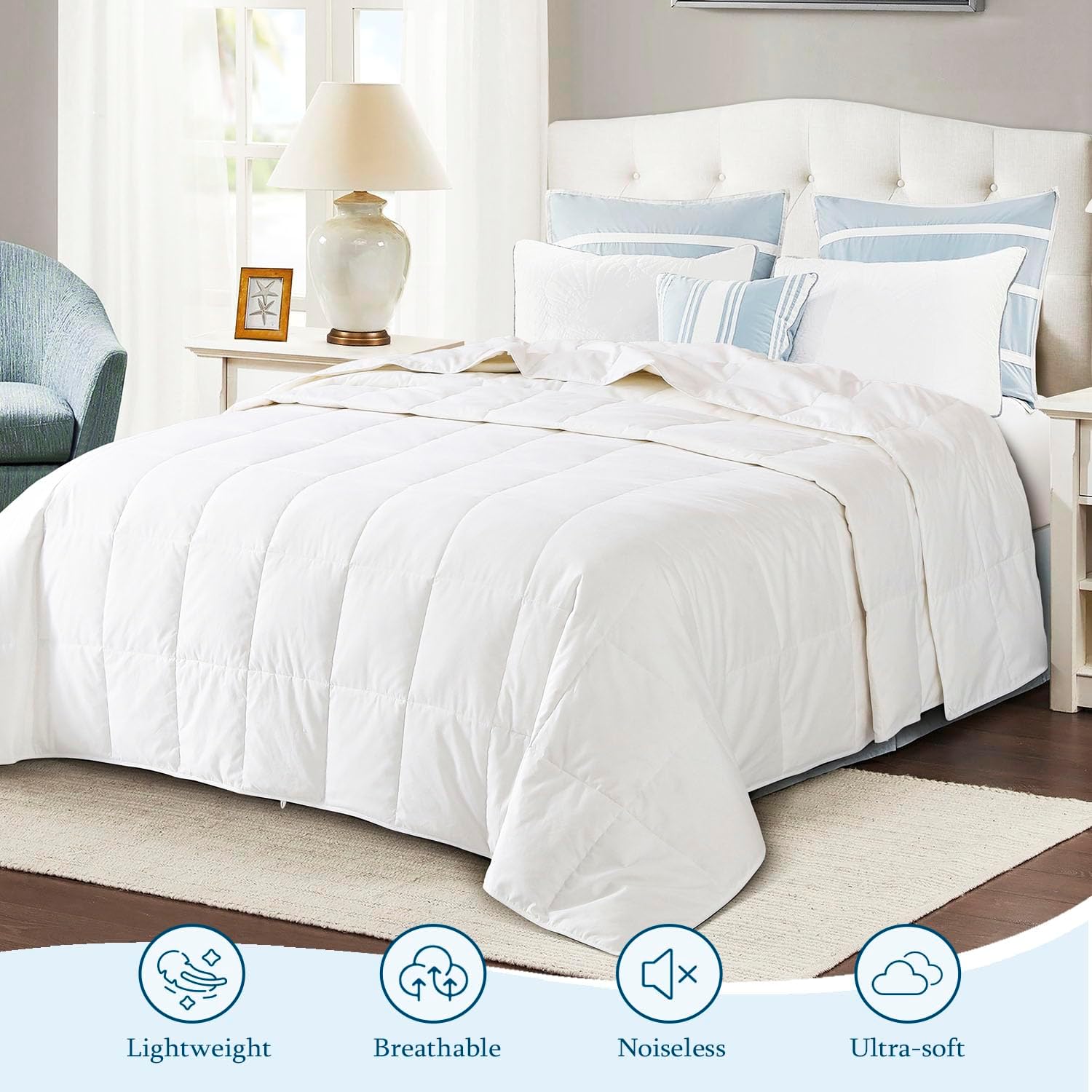
If you’ve ever woken up at 2 a.m. in a Houston summer kicking the covers off — or worse, lying there sweating because you refuse to sleep uncovered — this article is for you. A comforter is simply the filled blanket that goes on top of your bed; the “fill” is what’s stuffed inside (either real down from geese or ducks, or a synthetic alternative made from polyester fibers). Most comforters sold in the U.S. are designed for four-season climates, which means they’re too warm for a Florida bedroom in July, or for anyone who simply runs hot year-round. The good news: a genuine category of lightweight and summer-weight options exists — and choosing the right one isn’t just about picking the thinnest thing on the shelf. It’s about understanding three distinct product types, two or three key specs, and a handful of real-world signals from owners who have already slept through the summer in your climate.
Here’s what this guide covers: how to read the specs that predict warmth (fill weight, fill power, and shell fabric), which of the three product types fits your situation, and where the most credible owner feedback points for each tier.
| EDITOR'S PICKOlive + Crate Cooling Down Alte… | Mid-tierGlobon Summer Down Comforter Bl… | Budget pickAPSMILE Lightweight Feather Dow… | |
|---|---|---|---|
| Fill Material | Down Alternative | Down | Feather Down |
| Shell Material | Bamboo Viscose | — | Organic Cotton |
| Size | King | Queen | Queen |
| Dimensions | — | 90x90 in | 90x90 in |
| Fill Weight | — | 10 oz | — |
| Price | $119.99 | $119.99 | $79.90 |
| See on Amazon → | See on Amazon → | See on Amazon → |
The Three Product Types — And Why Conflating Them Leads to Bad Buys
This is the decision that most buyers skip, and it causes the most returns. Before you compare brand A versus brand B, you need to know which category you’re shopping.
Summer-weight down inserts use real goose or duck down at a dramatically reduced fill weight. Fill weight (measured in ounces) tells you how much insulating material is actually stuffed into the shell — a lighter fill weight means less warmth. A standard all-season down comforter might carry 20–30 oz of fill; a summer-weight version typically runs 10–15 oz. The shell is usually cotton percale or sateen, which breathes reasonably well. These are for buyers who specifically want the cloud-like loft and breathability of real down but need it dialed back significantly.
Down-alternative all-season inserts use synthetic polyester fibers — often branded as microfiber, gel fiber, or cluster-fiber — to approximate the feel of down. The best of these wick moisture better than down (which can clump when wet) and are hypoallergenic by default. Their warmth is tuned by the same fill-weight logic. The tradeoff: most synthetics don’t breathe quite as freely as high-quality down clusters, but the gap has narrowed considerably in premium alternatives.
Cooling-technology quilts are a third category that overlaps but shouldn’t be confused with either of the above. These use shells made from bamboo-derived viscose, Tencel lyocell, or phase-change materials — and sometimes carry a Q-Max rating (more on that below). They’re typically thinner than either type of comforter and designed more to regulate surface temperature than to provide loft. They serve hot sleepers who want the thinnest possible layer, not the fluffiest.
The tradeoff in plain terms: Real down breathes better and lasts longer; synthetics handle moisture better and cost less. Cooling-tech quilts run the coolest but sacrifice the enveloping feel that most comforter buyers are after.
The Specs That Actually Predict Performance for Hot Climates
Fill Weight: The Number That Matters More Than Fill Power
The Sleep Foundation’s cooling-comforter guidance consistently emphasizes fill weight over fill power for hot-climate buyers — and that’s correct. Fill power (a measure of how much space one ounce of down occupies; higher = fluffier and more insulating per ounce) is a quality indicator, not a warmth predictor by itself. A 700-fill-power comforter with 28 oz of fill will sleep warmer than an 800-fill-power comforter with 12 oz of fill.
The Spruce’s overview of fill power specs makes this distinction clearly: high fill power means better quality down, but without knowing the fill weight, you can’t predict warmth level. For Texas or Florida summers, target fill weights in the 10–14 oz range for a queen. For year-round use in a warm climate with air conditioning, 14–18 oz gives you a workable range.
By the Numbers: Fill Weight Benchmarks for Hot Climates
| Warmth Level | Fill Weight (Queen) | Best Climate Match |
|---|---|---|
| Summer / Ultra-Light | 10–14 oz | FL, TX, AZ summers; hot sleepers year-round |
| Light All-Season | 15–18 oz | Warm climates with AC; shoulder seasons |
| All-Season | 20–28 oz | Four-season climates; average sleepers |
Shell Fabric: Cotton vs. Bamboo — Does It Matter?
The short answer: yes, but not as dramatically as marketing suggests. Cotton percale (a plain-weave, matte-finish fabric) and cotton sateen (a smoother, slightly heavier weave) both breathe reasonably well. Good Housekeeping’s cooling-comforter coverage notes that percale tends to sleep cooler than sateen because of its looser weave structure.
Bamboo-derived viscose (often labeled “bamboo rayon” or “bamboo lyocell”) has a measurably smoother surface texture and wicks moisture more aggressively than standard cotton. Owners of bamboo-shell comforters with eczema or sensitive skin — not just heat sensitivity — frequently cite the fabric feel as the primary reason they chose it, per aggregated reviewer patterns. The Olive + Crate, which uses a bamboo shell, attracts this dual audience explicitly: reviewers cite skin feel and temperature regulation together in a way that cotton-shell comforters don’t.
Q-Max: Worth Understanding, Rarely Worth Obsessing Over
Q-Max (quantitative maximum heat flux) is a lab measurement of how quickly a fabric surface absorbs heat from skin — higher Q-Max values mean the material feels cooler to the touch instantly. It’s meaningful for phase-change fabrics and cooling mattress toppers. For comforter shells, it’s a real measurement but usually secondary to fill weight and construction. If a brand leads with Q-Max as its primary cooling claim, treat it as a signal that they’ve invested in fabric technology — but verify that fill weight is also lightweight, or you’re getting a cool-feeling surface over a warm core.
Who Each Product Type Serves — Mapped to Real Buyer Situations
You just moved from a cold climate to the South. This is an underserved but very real scenario — the APSMILE Lightweight is reviewed specifically by owners making this transition, describing the need for a “transitional solution” that provides coverage without the warmth of the comforter that served them well in their previous home. Down-alternative options at a light fill weight are often the right call here because they’re easy to layer (add a blanket in winter) and forgiving if your new climate turns out to have more AC than you expected.
You’re a hot sleeper who refuses to sleep uncovered. This is the core use case driving the entire lightweight category. Reviewers of the Globon Summer comforter — specifically Texas and Florida owners — describe it explicitly: the goal isn’t zero warmth, it’s enough coverage to feel comfortable without triggering night sweats. One owner describes it as “the perfect weight to not drown you and make you night sweat.” That language — coverage without consequences — is the buying signal to look for in reviews.
You or your partner are experiencing hormonal sleep disruption. The Amélie Home stands out in aggregated review patterns for this specific group. One reviewer going through menopause credits it with ending nighttime waking from overheating; another owner describes testing it on a husband “who wakes up sweating with our all-season duvet.” This is a distinct use case from simply preferring a cool sleep environment — it’s about physiological heat spikes that require a more aggressive solution than just reducing fill weight.
You have sensitive skin or eczema. The Olive + Crate bamboo-shell comforter draws a distinct audience: reviewers who chose bamboo specifically for skin reasons. If this is part of your decision, a bamboo shell isn’t a marketing claim — it’s a meaningful material difference, and the owner pattern supports it.
Year-Round Usability in Warm Climates: The Real Question
Can a lightweight down comforter work year-round in a warm climate? The honest answer: yes, with one caveat — “year-round” in Florida or Texas means air-conditioned interiors nearly every month. If your bedroom holds 68–72°F year-round because of AC, a 14–16 oz down or down-alternative insert will serve you across all twelve months. If you open windows in fall and genuinely get 50°F nights, you may want a slightly heavier insert or a second layer option.
The practical move for most warm-climate buyers isn’t to find a single comforter that works in all conditions — it’s to accept that a summer-weight insert is your primary layer and that it costs less to buy a simple blanket for the three weeks a year when you need more warmth.
Using a Lightweight Insert in a Duvet Cover Without It Looking Flat
This comes up constantly in buyer questions and deserves a direct answer. A lightweight insert — especially one with 10–14 oz of fill — will look and feel flatter than your neighbor’s fluffy all-season comforter. This isn’t a defect; it’s physics. A few ways to manage it:
- Buy for the right fill power. A 600+ fill-power down insert at lightweight fill weight will still loft better than a low-fill-power synthetic at the same weight. Higher fill power = more loft per ounce.
- Size up your insert. If your bed is queen, use a queen/full duvet cover with a king insert. The extra material creates more visual fullness.
- Layer intentionally. A folded blanket at the foot of the bed adds visual weight without adding sleeping warmth. This is how hotel beds look layered without being hot.
- Choose a structured duvet cover. A percale cover with a tighter construction holds its shape better than a loose-weave linen cover, which will drape flat regardless of fill.
Frequently Asked Questions
What fill weight is appropriate for hot climates like Texas or Florida summers? Target 10–14 oz for a queen-size insert if you’re sleeping in a regularly air-conditioned room. If summers in your area regularly push your bedroom above 72°F even with AC, go to the lower end of that range or consider a cooling-tech quilt with no traditional fill.
Does a bamboo shell actually keep you cooler than cotton? It does perform differently — bamboo-derived viscose wicks moisture faster and has a smoother surface that many owners describe as cooler to the touch. The difference is real but modest compared to the impact of fill weight. A bamboo shell over 28 oz of fill will still sleep warm.
Can a lightweight down comforter work year-round in a warm climate? Yes, for most air-conditioned homes in warm climates. A 14–16 oz fill covers the range between a cool-AC summer night and a mild Southern winter indoors.
What is Q-Max and does it matter when buying a cooling comforter? Q-Max measures how quickly a fabric pulls heat from your skin — higher values feel cooler on contact. It’s a real and meaningful measure for fabric technology, but it’s secondary to fill weight for most comforter buyers. Don’t let a high Q-Max rating distract you from a too-heavy fill.
Is down alternative or real down better for hot sleepers? Neither is universally better. Real down at low fill weight breathes very well and lasts longer. Down alternative handles moisture better (useful if you sweat heavily) and is hypoallergenic. The best choice depends more on fill weight than on fill type.
Can I use a summer-weight insert inside a duvet cover without it looking flat? Yes, but manage expectations: lightweight inserts loft less than all-season ones. Choose higher fill power to maximize loft per ounce, size up your insert, and layer a blanket at the foot of the bed for visual fullness without extra warmth.