June 25, 2026 • Margot Calloway • 11 min reading time • Prices verified June 4, 2026
The Crinkle Problem: Which Down Comforter Shells Are Actually Quiet at Night
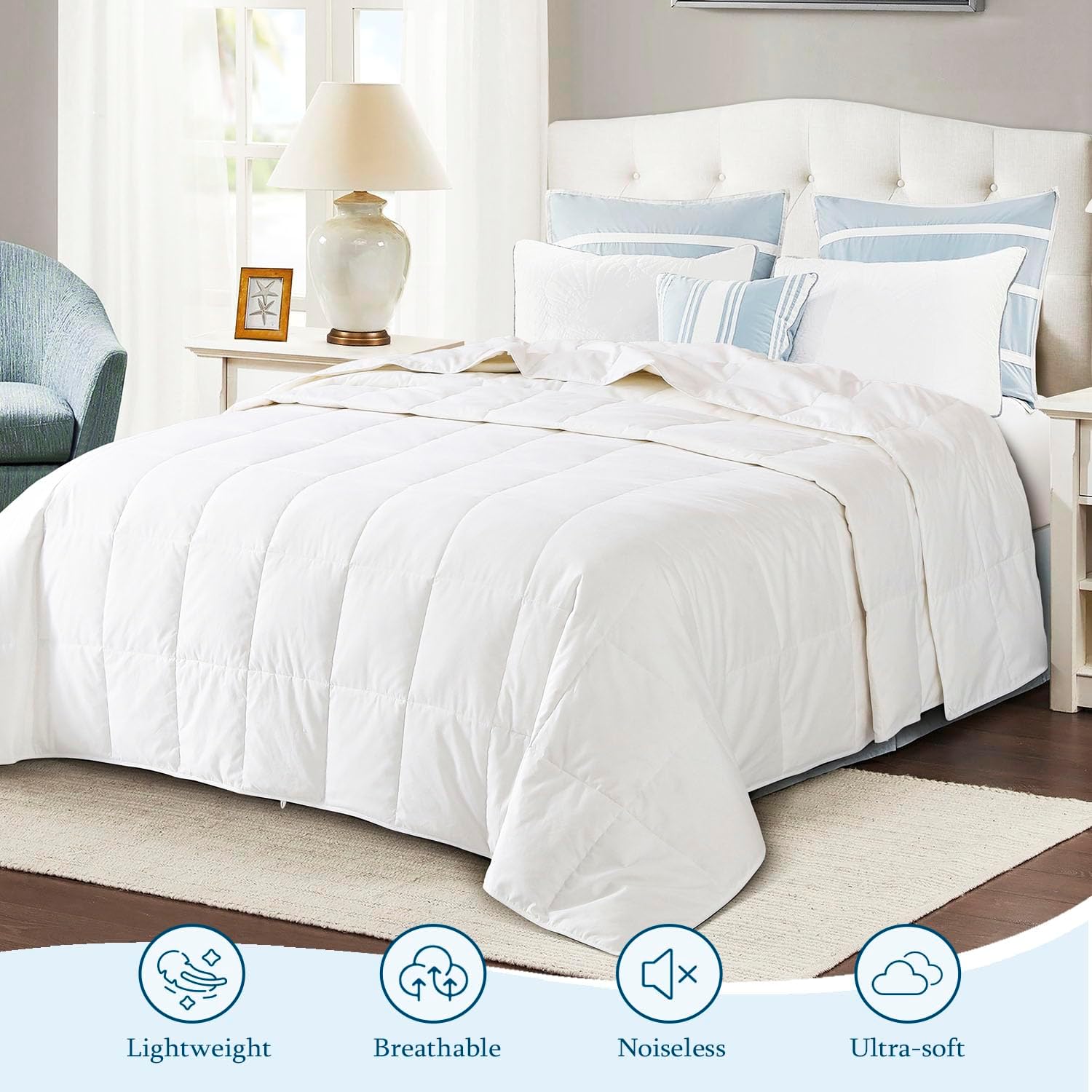
You’ve found a comforter you love on paper — the fill power (a number that measures how much loft, or fluffiness, one ounce of down creates) looks right, the fill weight (the total ounces of down inside) matches your climate, the shell fabric is described as “silky” in the listing. Then it arrives, and every time you roll over at 2 a.m. it sounds like someone crumpling a paper bag. That’s the crinkle problem. Shell noise — the rustling or crinkling sound that some down comforter outer fabrics make when they move — is one of the most-searched complaint terms in buyer reviews for this category, and it’s almost entirely invisible in product specs. Fill power gets a number. Warmth weight gets a chart. Shell noise gets nothing. This article synthesizes aggregated buyer review patterns, manufacturer marketing claims, and fabric construction principles. We read the spec sheets and the review threads so you can make the call before you buy.
| EDITOR'S PICK[Globon Winter White Goose Down…](https://www.amazon.com/dp/B071KK798X?tag=greenflower20-20) | Mid-tierC&W Goose Down Comforter Queen… | Budget pick[Three Geese Queen Size Goose Fe…](https://www.amazon.com/dp/B0B6NWPS8G?tag=greenflower20-20) | |
|---|---|---|---|
| Fill | 800 fill goose down | 750+ fill goose down | Goose feather down |
| Shell material | — | 100% Cotton | — |
| Thread count | 420 | — | — |
| Noiseless claim | ✓ | ✓ | — |
| Corner loops | ✓ | — | ✓ |
| Machine washable | — | ✓ | — |
| Price | $252.43 | $140.00 | $55.82 |
| See on Amazon → | See on Amazon → | See on Amazon → |
Why Shells Make Noise in the First Place
The shell — the woven outer fabric that contains the down — determines a huge portion of how a comforter feels, sounds, and holds up over time. Most comforter shells are woven from cotton, a cotton-polyester blend, or a microfiber polyester. The weave tightness (expressed as thread count, the number of threads per square inch of fabric) and the fiber type together dictate two things that matter for noise: downproofness and hand feel.
Downproofness means the weave is tight enough that fine down clusters and feather quill tips can’t poke through. To achieve that without an excessively stiff fabric, manufacturers have a few options: weave very tightly (high thread count, which can produce a denser, slightly stiffer hand), apply a finishing treatment to the fabric, or use synthetic microfiber, which is naturally fine enough to be downproof at lower thread counts. Each of these choices trades off differently on noise.
Where crinkle actually comes from: According to Apartment Therapy’s explainer on comforter construction and crinkling noise, the most common source of shell noise is a finishing treatment called calendering — a pressing process that closes the weave — or the use of a tightly woven but not fully broken-in cotton that still has residual stiffness from manufacturing sizing (a starch-like treatment applied during weaving). Microfiber polyester shells crinkle for a slightly different reason: the fiber bundles are smooth and low-friction against each other, which produces a higher-pitched, slippery rustle rather than the deeper paper-bag sound of stiff cotton.
The practical upshot: crinkle is a construction artifact, not a fill-quality signal. A $1,200 Hungarian goose-down comforter can crinkle. A $90 synthetic alternative can be nearly silent. The shell and the fill are almost entirely independent variables.
The Noise Spectrum: Four Shell Profiles Compared
After synthesizing buyer review patterns across this product set, the noise behavior of down comforter shells clusters into four recognizable profiles. The sections below address each one as a distinct comparison tier so you can locate yourself on the spectrum before choosing.
Silent or Near-Silent Shells
Shells described by reviewers as genuinely quiet tend to share one characteristic: a surface treatment or fiber choice that creates friction rather than slippage. Brushed microfiber — where the polyester surface is raised into a soft, slightly textured nap — absorbs movement rather than amplifying it. Heavy peached cotton (cotton that has been sanded to a suede-like finish) behaves similarly.
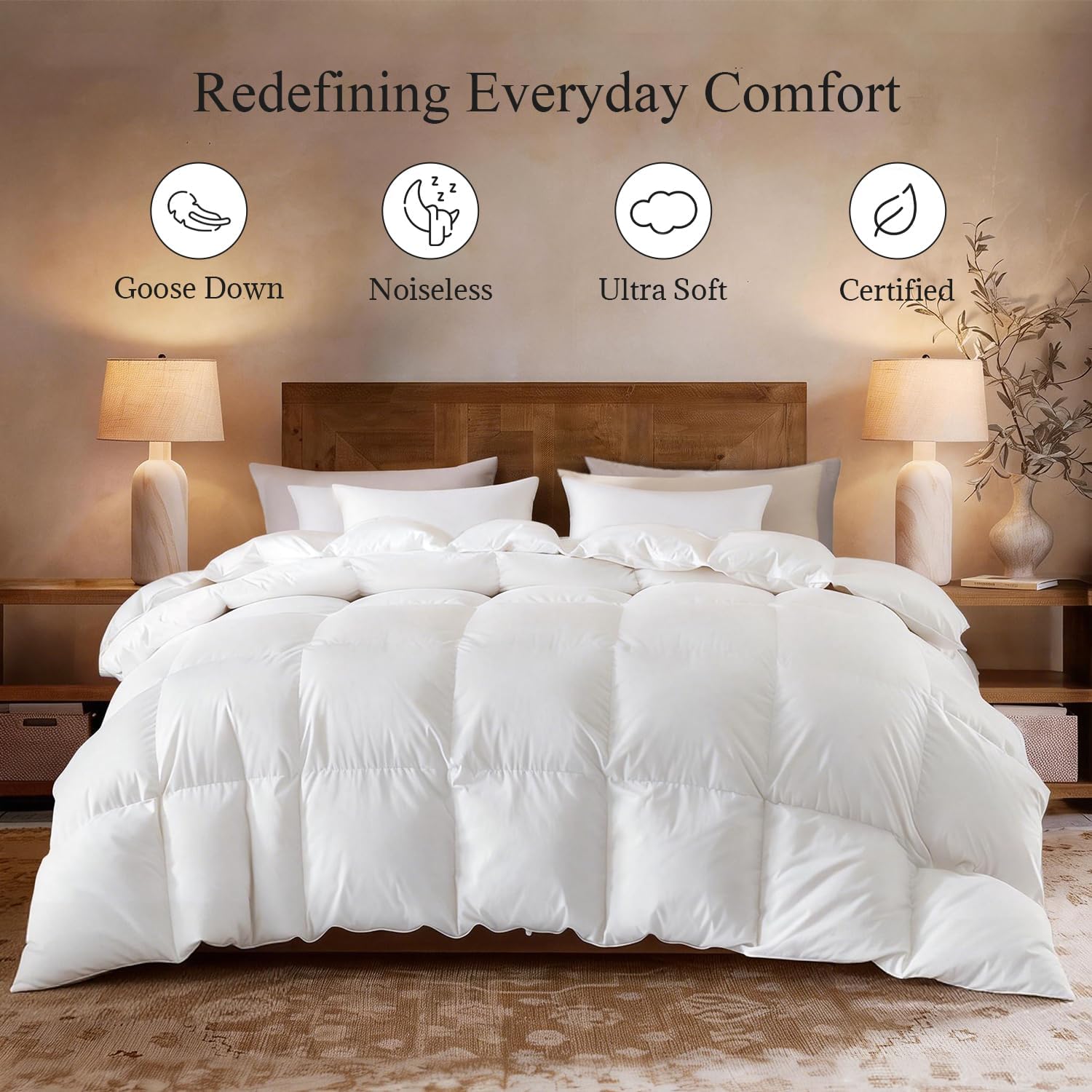
Globon explicitly markets its shells on both the 700 FP and 800 FP product lines as “noiseless,” and owners consistently confirm the claim. Across aggregated reviews, the pattern is unusually specific — buyers who purchased specifically because of a past crinkle complaint on another brand flag the Globon as a satisfying fix. The Globon Summer lightweight comforter earns the most concentrated praise for silence, which tracks: lighter-fill comforters move more freely under a sleeper, so shell noise on a summer weight is more noticeable if it’s present, and more conspicuously absent if the shell handles it well.
Three Geese buyers land in the same place, with reviewers specifically calling out that the fabric “doesn’t make any noise” — a phrasing that recurs across enough independent reviews to read as a genuine category differentiator rather than a few outliers.

Three
$55.82
In stock on Amazon
Check price on AmazonMild Crinkle: Acceptable to Most, Noticed by Some
This is the largest category. Standard cotton-polyester blend shells at the mid-market tier produce what aggregated reviewers describe as a soft rustle that fades into background noise within a week of regular use. Wirecutter’s long-term review methodology for its Best Down Comforter guide captures this dynamic well: noise complaints that appear in early reviews of a comforter often disappear in reviews written three to six months after purchase, suggesting break-in matters considerably.
APSMILE Oversized King buyers land here. The reviewer pattern is consistent: “a little crinkly” but “not a dealbreaker,” especially given the loft and warmth performance at the price. The framing is pragmatic — noise is acknowledged, not celebrated, and weighed against other attributes. Mid-market mainstream blends from comparable brands follow the same arc: initial soft rustle, gradual softening, minimal long-term noise for most sleepers.
C&W
$140.00
In stock on Amazon
Check price on AmazonAudible Crinkle: Accepted Trade-Off at the Premium Tier
Some comforters produce a definite, repeatable crinkle that buyers notice every night. Whether this reads as a flaw or a feature turns out to depend heavily on expectation and prior experience.
Canadian Luxury buyers are the clearest example of the pragmatic accommodation camp. Reviews acknowledge the crinkle openly — there is no pretending it isn’t there — but the framing is “acceptable given the quality and the price,” not “I wish it were quieter.” These buyers have decided the fill performance and construction quality warrant the trade-off. That is a legitimate conclusion, but it requires knowing the trade-off exists before you buy.
A distinct subset of buyers — particularly concentrated around FMQXMBZT oversized comforter and Ubauba reviews — actively celebrate the crinkle. The specific language that recurs is “hotel,” “crisp,” and “luxurious.” These buyers are pattern-matching the sound to high-thread-count percale cotton hotel bedding, where a slight rustle is a known tactile and auditory signature of tightly woven, downproof shell fabric. They are not wrong: a crisp, clean crinkle on a well-constructed shell is physically different from the harsh, plasticky rustle of a poorly finished synthetic. But the point stands — noise perception here is partly cultural and partly expectation-driven. If your mental model of a great comforter comes from a high-end hotel stay, you may actually prefer a shell with some acoustic presence.
Globon
$252.43
In stock on Amazon
Check price on AmazonDoes Thread Count Predict Quiet?
This is one of the most common misconceptions in the category, and the answer is: not reliably, and sometimes the relationship runs backwards.
The Sleep Foundation’s fill power and shell construction overview notes that shell thread count affects downproofness and feel, but the relationship between thread count and noise is not linear. A 400-thread-count cotton sateen — a weave with a high surface sheen — can be quieter than a 600-thread-count percale because the sateen float structure (where warp threads lie over multiple weft threads) creates a smoother, lower-friction surface. Percale, with its one-over-one-under crisp weave, is inherently more prone to the clean crinkle that hotel-fabric fans appreciate.
The Spruce’s Best Down Comforters buyer’s guide flags thread count as a quality proxy primarily for durability and feel, not silence. Good Housekeeping’s tested-and-reviewed methodology for down comforters notes similarly that shell noise correlates more with finishing treatment and fiber type than with raw thread count.
The practical decision rule: If silence is the priority, filter for brushed microfiber or explicitly marketed “noiseless” shells — not high thread count. A 300-TC brushed microfiber shell will very likely be quieter than a 600-TC percale from a brand that hasn’t addressed the noise variable at all.
Quick-Reference Comparison by Shell Profile
| Shell Profile | Typical Fiber | Noise Level | Key Brands (by review pattern) |
|---|---|---|---|
| Silent / near-silent | Brushed microfiber, peached cotton | None reported | Globon, Three Geese |
| Mild / fades with use | Cotton-poly blend | Soft rustle, breaks in | APSMILE, mid-market mainstream |
| Audible / accepted trade-off | Dense downproof cotton | Consistent crinkle | Canadian Luxury |
| Crinkle as feature | High-TC percale cotton | Crisp, hotel-style | FMQXMBZT, Ubauba |
Will It Go Away? Washing, Break-In, and Covers
Three real buyer questions converge here.
Break-in: Yes, for sizing-stiffened cotton shells, crinkle does typically diminish over two to four weeks of regular use as the fabric softens. This is the mechanism behind the pattern Wirecutter’s Best Down Comforter long-term review process observes — early reviews overrepresent noise complaints relative to owner reports written months after purchase.
Washing: A single wash cycle accelerates the break-in process significantly. The sizing treatment responsible for initial stiffness is water-soluble. Buyers who washed their comforter before first use consistently report less noise from the start. This is low-cost, zero-risk noise mitigation — if your crinkle bothers you, wash it before assuming the problem is permanent.
Duvet cover: This is the most effective mechanical solution. A duvet cover (a removable fabric envelope that encases the entire comforter) adds a second fabric layer between the shell and the air, which dampens sound transmission substantially. Apartment Therapy’s explainer on comforter crinkling noise confirms this is a standard recommendation from bedding specialists: the comforter still crinkles internally, but the sound doesn’t carry the same way. For a crinkle-sensitive sleeper using a comforter with an audible shell, a duvet cover essentially solves the problem.
The Decision Frame: Which Camp Are You In?
Shell noise is a preference axis, not a quality axis. Here is how to self-select.
If you are a light sleeper, share a bed with someone who is, or find any ambient noise disruptive at night: Prioritize explicitly marketed silent shells. Globon and Three Geese are the two comforters in this comparison where owners reliably confirm silence. A duvet cover adds insurance regardless of what you buy.
If you are shopping mid-market and noise isn’t a primary filter: The mild-crinkle category — APSMILE and comparable blends — is unlikely to be a meaningful issue after a few weeks of break-in or a single wash. Don’t let noise reviews written in the first week drive you off an otherwise well-matched comforter.
If you are noise-ambivalent or coming in with a hotel-bedding mental model: The audible-crinkle comforters — FMQXMBZT and Ubauba — may actually land better for you. The sensory experience matches a specific expectation, and buyer satisfaction in that segment is high among people who knew what they were getting into.
If you are considering Canadian Luxury: The trade-off is real and documented. The fill quality and warmth performance justify it for many buyers. Go in with eyes open, buy a duvet cover if you are uncertain, and wash it before first use.
The one thing to avoid: buying a comforter without knowing which camp you’re in, then attributing crinkle to a quality defect. It isn’t one. It’s a construction characteristic — and now you have the vocabulary to shop around it.
Frequently Asked Questions
Why does my new down comforter make a crinkling sound? New down comforter shells are often treated with a sizing agent during manufacturing — a starch-like finish that closes the weave for shipping and initial presentation. That residual stiffness produces the crinkle. It is not a defect. It typically softens with use over two to four weeks, and a wash cycle accelerates the process considerably.
Does a higher thread count shell mean a quieter comforter? Not reliably. Thread count affects durability and downproofness more than noise. Weave structure — sateen versus percale — and surface finishing — brushed, peached, or calendered — are stronger predictors of whether a shell will be quiet or crisp. A 300-TC brushed microfiber shell is likely quieter than a 600-TC percale.
Will the crinkle noise go away after washing? For most cotton shells, yes. The sizing treatment responsible for initial stiffness is water-soluble, so a single wash removes it and softens the fabric noticeably. Buyers who wash before first use consistently report less noise from the start. Microfiber shells crinkle for structural rather than chemical reasons, so washing helps less there — but those shells tend to start quieter.
Does putting a comforter inside a duvet cover eliminate the noise? It reduces it substantially. The cover adds a second fabric layer that dampens sound transmission. For crinkle-sensitive sleepers, a duvet cover is the most practical and lowest-cost fix regardless of which comforter you own.
Is shell noise a sign of poor quality or just a feature of real down? Neither, exactly. Shell noise is a construction characteristic of the outer fabric — it has almost nothing to do with fill quality, fill power, or whether the down is genuine. A premium Hungarian goose-down comforter can crinkle. An entry-level comforter can be silent. The fill and the shell are independent variables.
Which comforters in this comparison are explicitly marketed as noiseless? Globon is the clearest example, marketing “noiseless” shells across its 700 FP and 800 FP lines and earning owner confirmation at scale. Three Geese buyers independently describe silence without it being a primary marketing claim — which arguably makes the pattern more credible. No other comforter in this comparison makes an explicit noiseless claim that is consistently verified in aggregated buyer review patterns.