August 20, 2026 • Margot Calloway • 11 min reading time • Prices verified June 4, 2026
Pinch Pleat vs. Baffle Box vs. Box Stitch: Which Comforter Construction Do Buyers Actually Prefer
Walk into any bedding department — or scroll through 400 product listings at 11 p.m. — and you’ll run into three construction names over and over: baffle box, box stitch (sometimes called sewn-through), and pinch pleat. If you’re new to the category, these sound like furniture terms. They’re actually about how the top and bottom shell fabrics are connected, and that connection determines where your fill can go, how loft is preserved across the surface, and whether you’ll wake up with a warm center and cold edges after a year of use. This article breaks down each construction honestly — what the specs mean, what owners actually report, where each one earns its price, and which tradeoff matters most depending on what you’re buying and why.
If you’re somewhere in the $150–$800 range trying to decide whether construction should be a tiebreaker or a first filter, this is the guide for it.
| EDITOR'S PICKThree Geese Pinch Pleat Waterfo… | Mid-tierC&W Goose Down Comforter Queen… | Budget pickThree Geese Queen Size Goose Fe… | |
|---|---|---|---|
| Construction | Pinch Pleat | 3D Baffle Box | Baffle Box |
| Fill Material | Waterfowl Feathers/ Down | Goose Down | Feather/Down Fiber |
| Fill Power | — | 750+ | — |
| Shell Fabric | 1200TC Cotton | 100% Cotton | — |
| Size | King | Queen | Queen |
| Corner Loops | 8 Tabs | — | 8 Loops |
| Price | $145.98 | $140.00 | $55.82 |
| See on Amazon → | See on Amazon → | See on Amazon → |
What Each Construction Actually Does
Each of the three construction types solves a different problem — or ignores it entirely. Understanding the underlying mechanism makes the purchase logic clear across all price points.
Box Stitch (Sewn-Through): The Entry-Level Standard

Three
$55.82
In stock on Amazon
Check price on AmazonBox stitch is the simplest, oldest approach: the top shell and bottom shell are stitched together in a grid pattern, creating a checkerboard of small squares across the surface. There is no wall of fabric separating each square — the stitching is the wall, and it goes all the way through both layers.
The functional consequence: fill is trapped in each box, which prevents large-scale migration, but the stitch line itself contains no fill. Those seam lines are cold. At modest fill weights and with synthetic or low-loft down-alternative fill, the cold-spot effect is minor. With higher-fill-power down at a meaningful fill weight, the difference between the seam and the center of each box becomes noticeable — sometimes significantly so over a winter season.
Good Housekeeping’s 2025 comforter roundup notes that sewn-through construction is most appropriate for lighter-weight comforters, warm-climate use, or lower-cost builds where loft is not the primary selling point. Wirecutter (New York Times), in their review of the best down comforters, flags box-stitch construction as a meaningful downgrade signal at the $200+ price point specifically because of thermal bridging at seam lines.
Best for: Entry-level buyers, all-season or cooling comforters in warm climates, and anyone using a light fill weight where the warmth differential across seams is not meaningful. At the $60–$150 tier, box stitch is the norm, and it is not a flaw — it is a cost-appropriate choice.
Three
$55.82
In stock on Amazon
Check price on AmazonBaffle Box: The Thermal Performance Benchmark
C&W
$140.00
In stock on Amazon
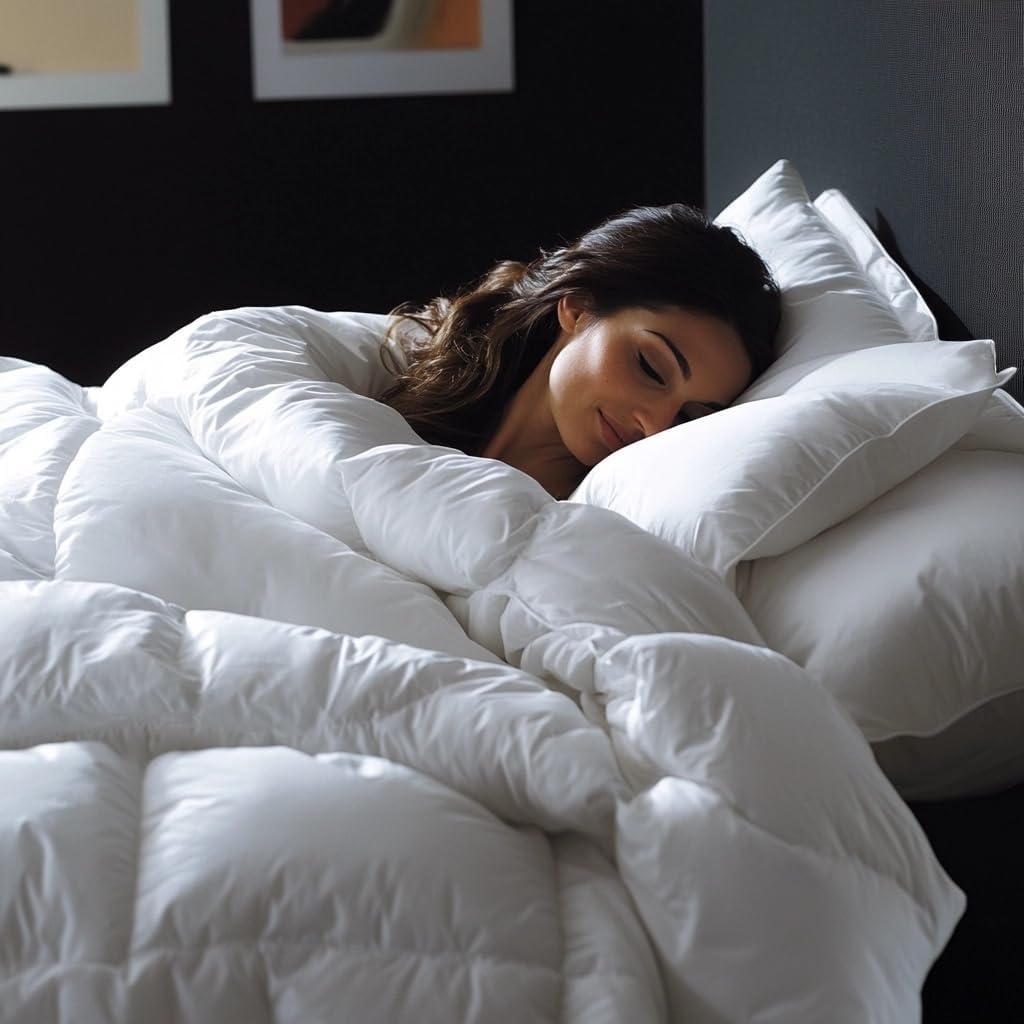
Check price on AmazonBaffle box construction solves the sewn-through cold-spot problem by adding a fabric wall — the “baffle” — between the top and bottom shells at each box boundary. Instead of the two shells being pinched together at the seam, they are connected by a strip of fabric that creates a three-dimensional channel. Down can fully loft within each box, and the seam line retains warmth because there is no direct compression point.
The Sleep Foundation’s overview of down comforters identifies baffle box as the benchmark construction for any comforter using high-fill-power down, precisely because the fill needs vertical space to expand fully. The Spruce, in their baffle box construction explainer, notes that the fabric walls reduce the tendency of down clusters to break down at compression points — a meaningful durability advantage for comforters laundered frequently.
The practical upshot, which owners across multiple price tiers consistently confirm: fill distribution stays more even over time, and the comforter retains its loft through repeated washing cycles.
One dimension that most buying guides skip: box size matters. Smaller chambers keep lighter fill from pooling, while larger chambers benefit heavier fill weights where you want maximum loft per section. This is a genuinely useful calibration if you are comparing two baffle-box comforters at similar price points — check the grid dimensions on the spec sheet, not just the construction name.
There is also a distinction worth naming: hidden baffle box vs. standard baffle box. In a standard build, the baffle walls run the full depth of the comforter and are sewn to both the top and bottom shell, so the grid is visible on both surfaces. In a hidden (or offset) baffle box, the seam lines on the top face do not align with those on the bottom, so neither surface shows a full grid. The thermal performance is equivalent; the visual difference matters if you use the comforter without a duvet cover or have a preference for a cleaner surface appearance. Hidden baffle box is common in hotel-grade and luxury-tier builds.
Best for: Anyone using 600+ fill-power down at a genuine fill weight. This is the right construction for the $250–$800 range, where the fill quality justifies a chamber that lets it fully loft.
C&W
$140.00
In stock on Amazon
Check price on AmazonPinch Pleat: The Design-Forward Choice
Three
$145.98
In stock on Amazon
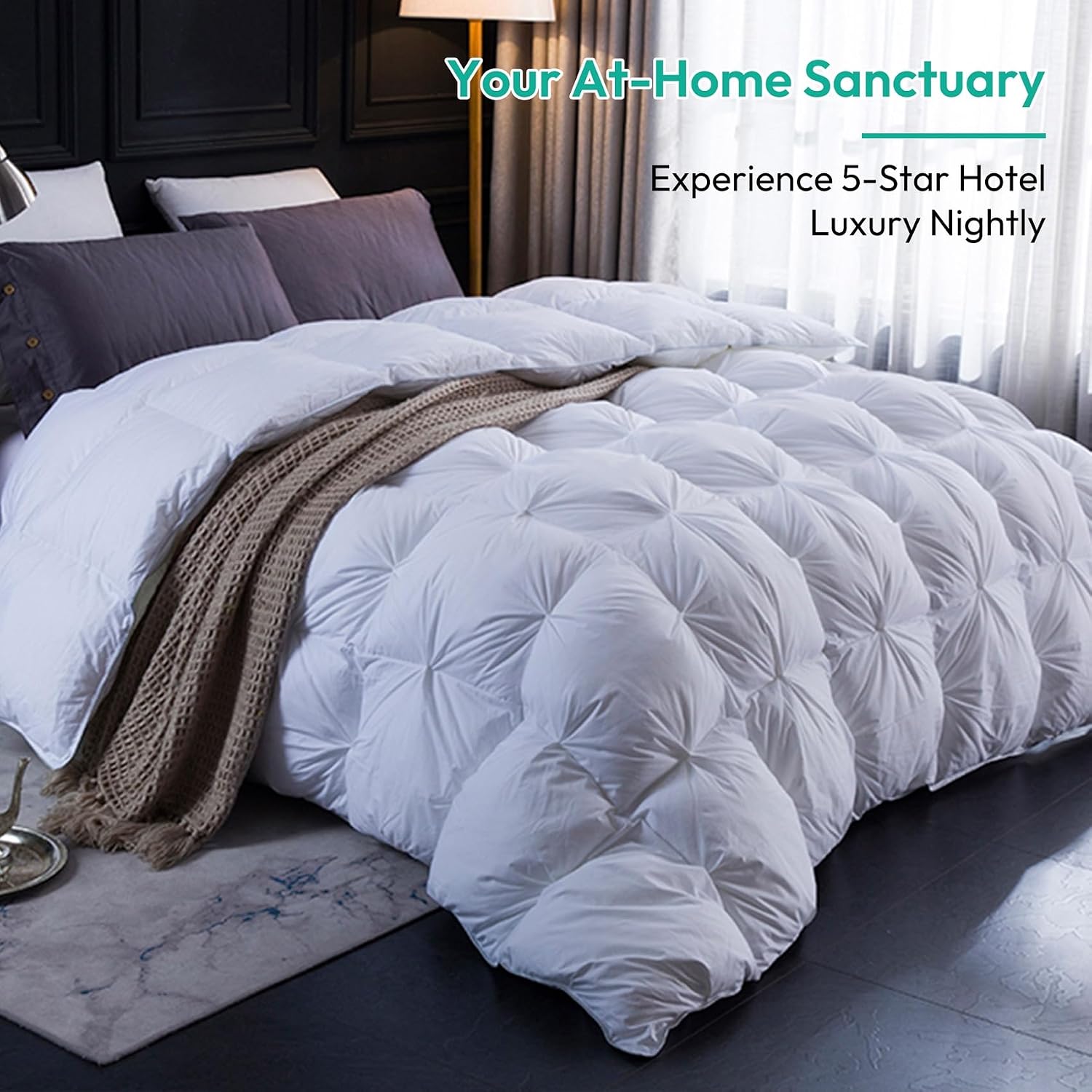
Check price on AmazonPinch pleat is the outlier in this comparison because it is primarily an aesthetic construction, not a thermal one. In a pinch-pleat comforter, the surface fabric is gathered at regular intervals and stitched into a raised pleat — creating a dimensional, quilted texture across the top of the bed. The underlying chamber structure can vary: some pinch-pleat comforters have baffle-box interiors, some have sewn-through boxes, and some use a different channeling method entirely.
The decorative effect is distinctive. Reviewers across the category return, unprompted, to words like “elegant” and “hotel-style” to describe the look. This is consistent with editorial coverage: Apartment Therapy has noted in its bedding coverage that pinch-pleat comforters are among the fastest ways to achieve a boutique-hotel aesthetic on a home bed without investing in a full duvet cover system.
The most strategically interesting product in this category is a hybrid construction — a pinch-pleat exterior design paired with a baffle-box interior. This combination solves the functional tension in the category: you get the aesthetic dimension of pinch pleat with the thermal performance of baffle construction. Buyers who specifically research construction before purchasing consistently report satisfaction with this combination, suggesting the market is aware of the tradeoff and is actively selecting for it.
Thermal performance in any pinch-pleat build depends entirely on the underlying chamber construction, not the surface pleating. When evaluating a pinch-pleat comforter, always check the product spec for the interior chamber type before drawing any conclusions about warmth or fill retention.
Best for: Design-forward buyers who want a statement bed without a duvet cover, boutique-hotel operators building a visual aesthetic, or anyone who has resolved the functional question (baffle box interior) and is now optimizing for surface appearance.
Three
$145.98
In stock on Amazon
Check price on AmazonThe Cold-Spot Problem: What the Evidence Actually Shows
The most frequently cited concern in construction research is cold spots at seam lines. Here is what the evidence supports across sources.
By the numbers:
- Box-stitch seam lines cover roughly 15–20% of the comforter surface area in a standard grid pattern
- Baffle-box construction eliminates direct thermal bridging at seams; editorial sources including the Sleep Foundation’s down comforter overview and the Spruce’s baffle box explainer both confirm that even warmth distribution is the primary functional advantage
- Wirecutter (New York Times) specifically notes in their down comforter review that buyers at the $200+ price point should treat box-stitch construction as a signal to look for a better-constructed alternative
- Pinch-pleat thermal performance depends entirely on the underlying chamber construction, not the surface pleating — a detail missing from most retail product descriptions
The takeaway: box-stitch cold spots are real but context-dependent. At a fill weight of 20–30 oz in a queen and a fill power below 600, the differential is minor. At 50+ oz and 700+ fill power, the seam compression is meaningful enough to justify the cost premium of baffle construction. Good Housekeeping’s 2025 roundup draws this line explicitly, recommending sewn-through builds only for lightweight or warm-climate applications.
How STR Operators and Interior Designers Should Think About Construction
For boutique-hotel owners and short-term rental Superhosts buying at the $300–$600 tier, the construction decision has a specific logic that differs from a homeowner’s.
The primary risks in an STR context are: (1) uneven wear from frequent laundering, (2) fill migration after repeated guest use, and (3) visual presentation on the bed between stays. Baffle-box construction holds up better to repeated washing because the fill is physically constrained within each chamber — it cannot consolidate over time the way it can in a sewn-through build. The Spruce’s baffle box construction explainer specifically notes that the fabric walls reduce compression-point breakdown in down clusters, which translates directly to longer useful life in high-turnover environments.
Pinch pleat is a genuine differentiator for operators who make the bed without a duvet cover — the textured surface reads immediately as premium in listing photography and in person. The hybrid construction (pinch-pleat exterior, baffle-box interior) is particularly well-suited here because it solves both the guest-impression problem and the durability problem simultaneously.
For pure function over form — a property where duvets are always used and the comforter is never visible — the construction decision narrows to baffle box for longevity, and the aesthetic variable drops out entirely.
Frequently Asked Questions
Does a pinch pleat comforter need a duvet cover, or can it be used alone? It can absolutely be used alone — and that is largely the point. The textured surface is designed to be a visual finish on the bed. If you are using a pinch-pleat comforter without a cover, check that the shell thread count is high enough to resist direct skin contact wear (300+ is a reasonable floor). A duvet cover over a pinch pleat will flatten the surface texture and defeat the aesthetic purpose.
Will baffle-box construction prevent fill from shifting to the edges over time? Better than sewn-through, yes — but not perfectly. Each baffle chamber contains fill within its boundaries, so you cannot get full migration from center to edge across the whole comforter. What you can get is uneven fill density within chambers if the original fill weight was low. Higher fill weight per chamber reduces this; it is one reason fill weight (oz) matters alongside fill power (the quality metric) when comparing baffle-box builds.
What is the difference between a hidden baffle box and a standard baffle box? In a standard baffle box, the grid of stitching is visible on both the top and bottom surfaces. In a hidden (offset) baffle box, the seam positions on the top face do not align with those on the bottom, so neither surface shows a full grid. The thermal performance is equivalent; the visual difference matters if you use the comforter without a cover or have a preference for a cleaner surface appearance.
Does box-stitch construction cause cold spots? At high fill weights and high fill power, yes — the compression at stitch lines reduces loft and creates seam channels with less insulating fill. The effect is most noticeable in winter-weight builds. At lighter fill weights appropriate for warmer climates or summer use, the differential is minimal and box stitch is a cost-appropriate choice.
Is a pinch pleat the same as a baffle box? No — they describe different things. Baffle box refers to the internal chamber construction (fabric walls between the shells). Pinch pleat refers to the exterior surface design (gathered, stitched pleats on the face fabric). A comforter can have one, both, or neither. When evaluating a pinch-pleat comforter, always check the product spec for the underlying chamber construction to understand what the thermal performance will actually be.
The Decision Rule
If you are in the middle of a purchase decision right now:
- Warmth performance and long-term fill distribution are your primary concerns, and you are spending $200 or more: baffle box is the non-negotiable baseline. Box size matters — smaller chambers for lighter fills, larger for heavier.
- You are building a visual bed aesthetic and intend to use the comforter without a duvet cover: pinch pleat earns its premium for the surface texture alone. Verify the interior construction before buying.
- You are buying a summer-weight, synthetic-fill, or sub-$150 comforter: box stitch is appropriate. You are not leaving meaningful performance on the table at this price and fill weight.
- You want both the hotel look and functional performance: the hybrid pinch-pleat/baffle-box construction is the most honest solution in the category — it does not force a choice between aesthetics and durability.
Construction is not the only variable in a comforter purchase, but it is the one most likely to determine whether a $400 investment still performs in year five — or starts showing cold spots by year two.