August 29, 2026 • Margot Calloway • 10 min reading time • Prices verified June 4, 2026
Vacuum-Sealed and Skeptical: What Happens When You Open a Compressed Comforter
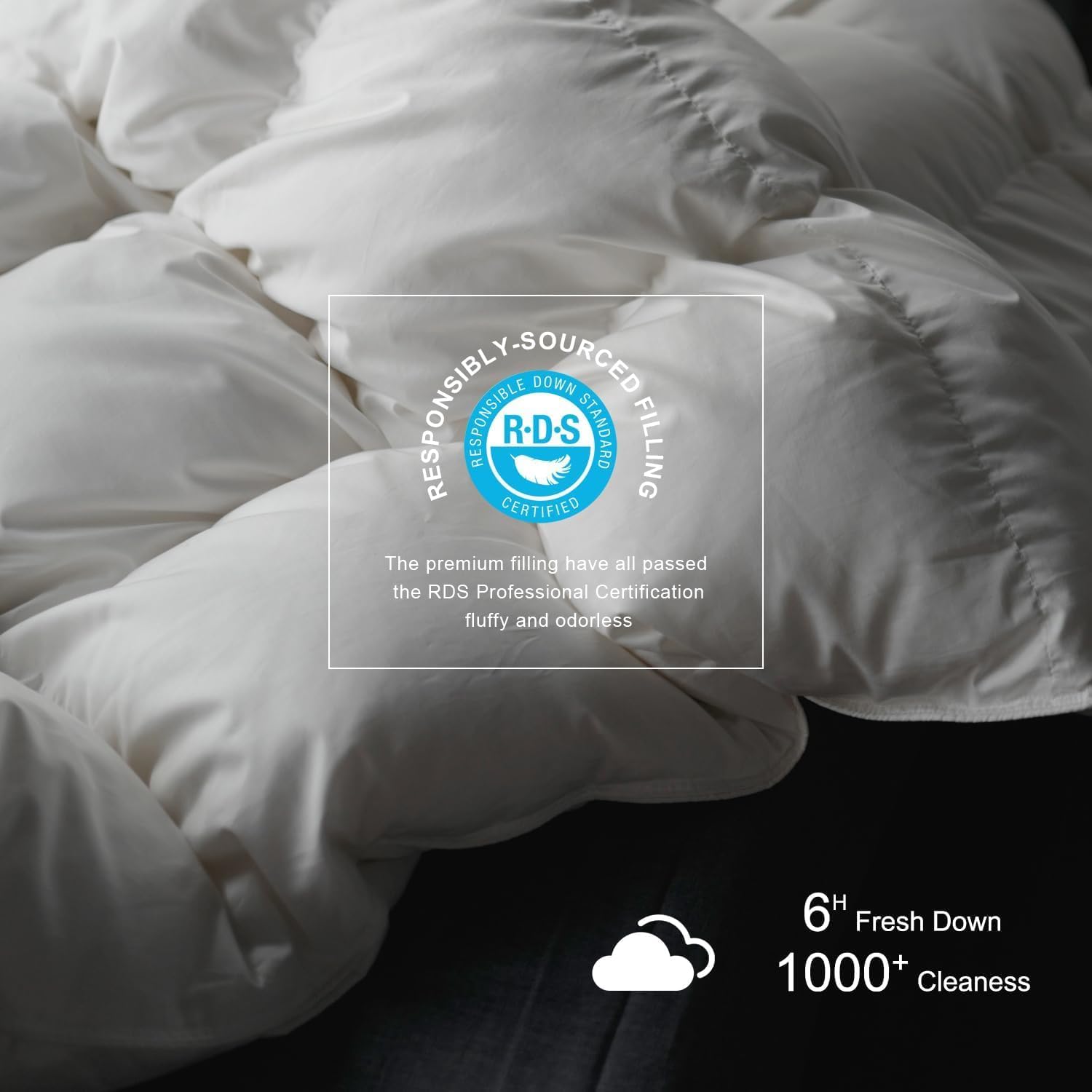
You ordered a down or down-alternative comforter online. It arrived in a box about the size of a carry-on bag. Inside: a flat, dense, shrink-wrapped rectangle that looks less like bedding and more like something you’d use to patch drywall. If your first thought was this is wrong, you are not alone — and you are not right. Vacuum-sealing (compressing a comforter by removing the air around it so it ships and stores in a smaller package) is standard practice across almost every price tier, from entry-level polyester fills to mid-range down-alternative blends. The compression does not damage the fill when the comforter is made correctly and recovered correctly. What this guide covers: why compression happens, what recovery actually looks like on a real timeline, how to use a dryer correctly to speed the process, what genuine warning signs look like (versus normal anxiety), and how to store your comforter without ruining what you just restored.
| EDITOR'S PICKpuredown® Goose Down Comforter… | Mid-tierL LOVSOUL Goose Feather Down Fi… | Budget pickRoyoliving Premium Lightweight… | |
|---|---|---|---|
| Fill Power | 800 | 750+ | — |
| Fill Type | Goose Down | Goose Feather/Fiber | Feathers Down |
| Shell Material | 100% Cotton | 100% Organic Cotton | 100% Cotton |
| Thread Count | 700 | 1200 | — |
| Size | King | King | Queen |
| Corner Tabs | — | ✓ | ✓ |
| Price | $436.99 | $99.99 | $95.99 |
| See on Amazon → | See on Amazon → | See on Amazon → |
Why Manufacturers Compress Comforters in the First Place
The short answer is economics and logistics. A queen-size down comforter at its natural loft takes up roughly the same volume as a large duffel bag. Shipping that volume costs significantly more than shipping a compressed brick — and the savings flow partly to the buyer in the form of lower prices or free shipping thresholds. Vacuum-sealing also eliminates the risk of the comforter shifting inside the box during transit, which can cause baffled-box construction (the internal fabric walls that keep fill evenly distributed) to deform under pressure from loose movement.
The process works because down clusters and most synthetic fills are highly compressible — their structure is essentially a three-dimensional lattice of air pockets. Compress the lattice, remove the air, and you get a dense flat panel. Reintroduce air — by cutting the bag and letting time or gentle heat do the work — and the lattice rebounds. The Sleep Foundation’s overview of down comforter construction notes that fill power (the measure of how much volume one ounce of down occupies) is a direct proxy for this resilience. An 800-fill-power Hungarian goose down rebounds faster and more completely than a 550-fill duck down, because higher-fill-power clusters are larger and more three-dimensionally intact.
Down-alternative fills — typically polyester microfiber clusters engineered to mimic the loft of natural down — also rebound well, but the mechanism is different: it’s the crimp and curl of individual fibers reasserting themselves rather than clusters re-expanding. Owners of products like CozyLux and L LOVSOUL consistently report that synthetic fills can recover noticeably within the first hour of opening, sometimes faster than natural down.
The Real Recovery Timeline: What Reviewers Actually Report
Here is where the anxiety usually lives: you opened the bag two hours ago, the comforter is still visibly flatter than you expected, and you are wondering whether you have a defective product. Aggregated owner reports across down and down-alternative products tell a consistent story, and it is worth knowing the actual numbers before you panic.
By the numbers:
- Air-only recovery (no dryer): 4–24 hours for synthetic fills; 12–48 hours for natural down
- Low-heat dryer cycle: 15–30 minutes typically restores working loft for both fill types
- Full loft stabilization (clusters fully re-expanded and redistributed): up to 48 hours for premium down fills, per APSMILE’s own care documentation
L LOVSOUL buyers who air-dried without a dryer note complete recovery within a few hours under normal room conditions. Royoliving owners report that 15 minutes in the dryer on low heat fully restores loft without any sign of heat damage to the shell. The CozyLux buyer cohort frequently describes the expansion as nearly instantaneous after cutting the vacuum bag — “instantly swelled” is a phrase that reappears in the owner record — though this reflects synthetic fill behavior, not down. The APSMILE documentation is the most conservative and probably the most honest: they advise buyers to wait two full days before making any judgment about whether loft has fully recovered. That advice is good across the category.
The Spruce’s guide to fluffing down comforters recommends the dryer-plus-tennis-ball method specifically because the mechanical agitation breaks up fill clumps that form during compression, redistributing clusters evenly across the baffles. Two or three clean tennis balls (or a purpose-made dryer ball set) tumbling with the comforter on low heat is the consensus best practice across care documentation and owner reports alike.
The Dryer Protocol: How to Do It Without Causing Damage
The most common mistake is going too hot. Down clusters can withstand moderate heat, but sustained high heat degrades the keratin structure of the feather barbules — the microscopic hooks that give clusters their three-dimensional shape. Once that structure is damaged, the cluster cannot fully re-expand. Cotton and cotton-blend shells face a related but different risk: high heat causes shrinkage and can stress the ticking weave, which over time lets fill work through the shell (a phenomenon called fill migration or fiber bleed).
The correct protocol, consistent across Good Housekeeping’s washing guide and The Spruce’s fluffing guide:
- Set the dryer to low heat or the air-fluff setting. If your dryer runs hot on “low,” use air-only.
- Add two or three clean tennis balls or wool dryer balls. They break up clumps mechanically.
- Run for 15–20 minutes, then pause and manually redistribute. Pull the comforter out, shake it, and feel for any remaining dense spots. Reload.
- Repeat until the fill feels even and the comforter has regained visible loft.
- Before putting it on the bed, lay it flat for 30 minutes. This allows any residual moisture from the compression bag to fully evaporate.
For oversized or California-king comforters, a commercial-sized dryer (the kind at a laundromat) is often more effective than a home unit because the comforter can tumble freely rather than balling up against the drum walls. Balling is the enemy of even loft recovery.
What Lumps After Fluffing Actually Mean
Not all lumps are the same, and the distinction matters for how you respond.
Lumps that resolve with additional drying or air time are compression artifacts — fill that hasn’t fully re-expanded or redistributed yet. These are normal within the first 48 hours. The fix is more time, more gentle agitation, or another low-heat dryer cycle.
Lumps that persist after 48 hours and a dryer cycle suggest one of two things: either the fill has clumped due to moisture (a manufacturing or transit issue, and a legitimate warranty claim) or the baffle construction has failed, allowing fill to migrate into one section. Feel the lump — if it moves when you push it and redistributes somewhat, it’s a clump. If it feels anchored or the surrounding area feels empty, it may be a baffle failure.
Lumps that develop after washing are the most cautionary data point in the owner record for this category. The Luxurious Egyptian Cotton repeat buyer who washed rather than dry-cleaned their comforter reported permanent lumps forming within a year. This is a direct consequence of the fill getting wet, clumping during the wash cycle, and not being fully dried before storage — allowing clumps to set. Good Housekeeping’s washing guide is explicit: if you wash a down comforter at home, it must be dried completely, which often requires two to three full dryer cycles at low heat, not one. A comforter that feels dry on the outside can still have damp fill in the center. That residual moisture is what causes permanent lumping.
If you have a premium fill — 700+ fill power, RDS-certified natural down — dry cleaning is worth the cost. Real Simple’s storage guide recommends dry cleaning before long-term storage specifically because professional cleaning removes oils and debris that can degrade fill over time, and the drying is done correctly at commercial scale.
Storage: The Canvas Bag Question and the Re-Vacuum-Sealing Temptation
Many comforters ship with a canvas or cotton storage bag. The question owners frequently ask: is it actually useful, or is it just packaging theater?
The honest answer is: useful for the right conditions, not sufficient for all conditions. A breathable canvas bag is appropriate for short-term storage (seasonal, under a year) in a climate-controlled environment with low humidity. The breathability matters because any residual moisture in the fill needs somewhere to go. Sealed plastic bins or — critically — vacuum storage bags are inappropriate for long-term storage of any filled bedding. Real Simple’s storage guide explicitly warns against vacuum-sealing for storage purposes: repeated compression and re-expansion cycles gradually degrade fill cluster structure, and storing compressed for more than a few weeks risks permanent loft loss.
This is the important distinction between shipping compression (brief, controlled, designed for the fill type) and storage compression (indefinite, uncontrolled, damaging over time). When a manufacturer vacuum-seals a comforter for shipping, they are compressing it for days or weeks at most. When a consumer re-vacuum-seals a comforter for the off-season, it may sit compressed for four to six months. That duration is long enough to cause structural damage to down clusters that no amount of dryer time will fully reverse.
If you don’t have a cedar chest or dedicated linen closet, the canvas bag that came with the comforter, placed in a cool dry spot, is genuinely the right call. If you’re storing in a basement or garage with humidity variation, add a breathable desiccant packet to the bag and check it once mid-season.
Frequently Asked Questions
Do I need a dryer or can I just air it out? For synthetic fills, air-only recovery works reliably within a few hours in normal room conditions — L LOVSOUL owners confirm this. For natural down, air-only works but takes longer (up to 48 hours) and won’t break up dense clumps as effectively as mechanical agitation. If you have a dryer available, use it on low heat; if you don’t, air recovery works, just give it more time and manually shake and redistribute the fill every few hours.
How long does it take for a compressed comforter to fully fluff? Synthetic fills: a few hours to overnight, with a dryer cycle cutting that to 20–30 minutes. Natural down: allow up to 48 hours for complete loft stabilization, even after a dryer cycle. APSMILE’s own care documentation recommends the full two-day window before drawing conclusions.
Can I re-vacuum-seal my comforter for storage without damaging it? No — not for storage periods longer than a few days. Repeated or prolonged vacuum compression degrades fill cluster structure. Use a breathable canvas or cotton bag instead.
What does it mean if my comforter still has lumps after fluffing? Within the first 48 hours, lumps are normal compression artifacts. After 48 hours and at least one dryer cycle with agitation: if the lump moves and redistributes, it’s a clump that needs more drying time. If it feels anchored, check for baffle failure. If lumps appeared after washing, the fill may have dried in a clumped state — this is the hardest to reverse and the best argument for dry cleaning premium fills.
Is the canvas storage bag that comes with some comforters actually useful? Yes, for breathable short-term storage in a climate-controlled space. It’s not adequate for humid basements or multi-year storage without additional moisture control.
Will the dryer damage my cotton shell or fill? On low heat or air-fluff, no — this is the consensus across Good Housekeeping and The Spruce’s care documentation, and it aligns with what owners report in practice. High heat is the risk: it shrinks cotton shells and degrades down cluster structure. Keep it low and check the comforter between cycles.